
Best Scrubs for Nurses: 7 Checks Before You Buy
The best scrubs for nurses are the pair that follows your workplace rules, fits through the movements you actually make, carries only your permitted items, and can be tried without multiplying one bad decision across a full rotation. Start with the written uniform requirements, then test one top and one pant indoors before buying more.
Do not choose from softness, pocket count, or price alone. A top can look right while standing and pull upward when you reach. A pant can fit empty and slide when one pocket is loaded. A color can look close online and still be wrong for a unit that specifies an exact shade.
Evidence boundary: LumiScrubs publishes this guide and sells the sets linked below. We have not published a controlled full-shift comparison proving that one LumiScrubs set is best for nurses, cooler, more durable, more secure under pocket load, or a universal fit. Product facts and images were checked on August 27, 2026; images support visible construction only.
What “best” means for a nursing scrub set
“Best” is not one fabric, silhouette, brand, or pocket total. It is a sequence of passed decisions:
- The garment is allowed.
- The top and pant fit separately.
- Coverage holds through work movement.
- The storage layout matches a permitted load.
- Layers and fabric choices fit the environment.
- The color and appearance remain acceptable in relevant lighting.
- The first order stays small enough to reverse if the set fails.
That order prevents a common buying error: solving an easy preference before a controlling rule. The softest top is still the wrong purchase if its color, neckline, logo, or visible layer conflicts with written requirements.
1. Get the written uniform rules first
Ask a manager, educator, recruiter, or uniform coordinator for the current written instructions. Confirm:
- exact color name and whether tops and pants must match;
- required or prohibited logos, patches, or embroidery;
- allowed necklines, pant shapes, cuffs, and visible layers;
- footwear color and coverage rules;
- whether the employer supplies or launders any garments;
- whether orientation or temporary assignments use different attire.
“Navy scrubs” is incomplete if a specified vendor, shade code, or embroidered identifier also controls the purchase. A colleague on another floor may follow a different rule.
Use the scrub colors guide to understand color families, but treat the local written rule as the final answer. An online swatch cannot certify an exact workplace match.
2. Fit the top and pant as two decisions
Many people need different letter sizes above and below the waist. Measure a top and pant that already work, then compare each garment separately.
For the top, record chest width, shoulder width, body length, sleeve opening, and hem width. For the pant, record relaxed waistband width, hip width, rise, thigh width, inseam, and leg opening. The Fit & Size guide owns the current measurement tables; the guide to mixing top and pant sizes covers the separate-size decision.
Keep the tags attached during the eligible indoor try-on. If the top passes but the pant fails, change the pant—not the whole set by default. Letter-size symmetry is less important than two garments that work together.
3. Test movement before judging the mirror
Stand naturally, then reproduce a short, repeatable sequence:
- Reach forward and overhead.
- Cross both arms in front of the body.
- Sit for two minutes.
- Stand without pulling the waistband upward.
- Squat, bend to knee height, and climb one safe step.
- Walk in the shoes you plan to wear.
Watch the neckline, shoulder seam, top hem, waistband, rise, knee, and pant hem. Write observable changes: the top hem lifts above the waistband; the neckline opens when leaning; the seat pulls the waist down; the cuff rides upward; the straight hem meets the shoe.
One indoor screen cannot prove twelve-hour comfort or garment life. It can expose a size or shape mismatch before washing removes the return option.
4. Map pockets to permitted items, then add load
List what must stay on your body, what is task-specific, and what belongs on a cart, desk, or workstation. Give each permitted item a reachable location instead of shopping by the largest advertised pocket count.
Use blunt, safe stand-ins in an eligible indoor try-on. Add one item at a time, then repeat sitting, walking, bending, and stepping. Watch for a pocket opening that gaps, a rigid item that presses into the body, a side seam that twists, or a waistband that moves only after loading.
The guide to scrubs with pockets owns the pocket-count and placement decision. The 12-hour shift pocket test is the tracking route when your loadout changes across shifts.
A gallery can show an opening, zipper, divider, or cargo location. It cannot prove capacity, containment, seam strength, closure life, or waistband stability.
5. Plan for heat, cold, and visible layers separately
A room can feel cold during one task and warm during another. Start with the workplace rule for visible sleeves and outer layers. Then decide whether you need a removable layer, a base layer, or no extra garment.
Check the arm opening, neckline, cuff, and hem where two garments meet. Sit, reach, and bend with the intended combination. A base layer that bunches at the elbow or pulls the scrub top out of place has failed even if both pieces fit alone.
Use what to wear under scrubs for the layering decision. If heat is the main problem, the breathable scrubs guide explains what can be checked before buying without pretending that a fabric name proves a cooler shift.
6. Check coverage where the lighting catches problems
Test the complete outfit with the intended base layer, under bright front and back lighting. Stand, sit, bend, and squat while a trusted person or a phone camera checks the back and side views. Repeat with pocket stand-ins because load can change drape and waistband position.
Look for visible underlayer edges, a top hem that separates from the pant, fabric that becomes more revealing when stretched, and a pant hem that touches the floor or catches under a shoe. The separate guide to scrubs that are not see-through gives a repeatable lighting and movement screen.
Color also changes across daylight, warm indoor light, and cool overhead light. Compare the top and pant together; a shared color name does not mean an exact match across different products or brands.
7. Buy the first set as a reversible test
Before ordering, read the current Shipping & Returns terms. Keep the first decision small enough to reverse: one top and one pant, or one complete set with independently selected sizes.
Run every allowed indoor check before washing, removing tags, embroidering, or altering the garment. If the pair passes, record the product name, top size, pant size, color, and purchase date before expanding the rotation. Do not rely on the brand name and color alone; those details may not identify a future reorder precisely.
Build quantity from the longest gap between laundry days, the number of scheduled shifts, employer-provided garments, and one realistic backup. There is no universal rotation number for every nurse.
Compare four current LumiScrubs set paths
The table below reports current catalog configuration, not a shift result. Price and product-level availability can change; this snapshot was checked on August 27, 2026.
| Current set | Published configuration | Current price | Use the page to compare |
|---|---|---|---|
| Women’s Core Scrub Set | V-neck top and straight-leg pant; top and pant sizes selected separately; three top pockets and nine pant pockets | USD 64.90 | A women’s straight-leg route |
| Men’s Core Scrub Set | V-neck top and straight-leg pant; top and pant sizes selected separately; four top pockets and nine pant pockets | USD 64.90 | A men’s straight-leg route |
| Women’s Motion Scrub Set | Coordinated top and tapered jogger pant; top and pant sizes selected separately; elasticated pant cuff | USD 64.90 | A women’s jogger route |
| Men’s Motion Scrub Set | V-neck top and tapered jogger pant; top and pant sizes selected separately; elasticated pant cuff | USD 64.90 | A men’s jogger route |
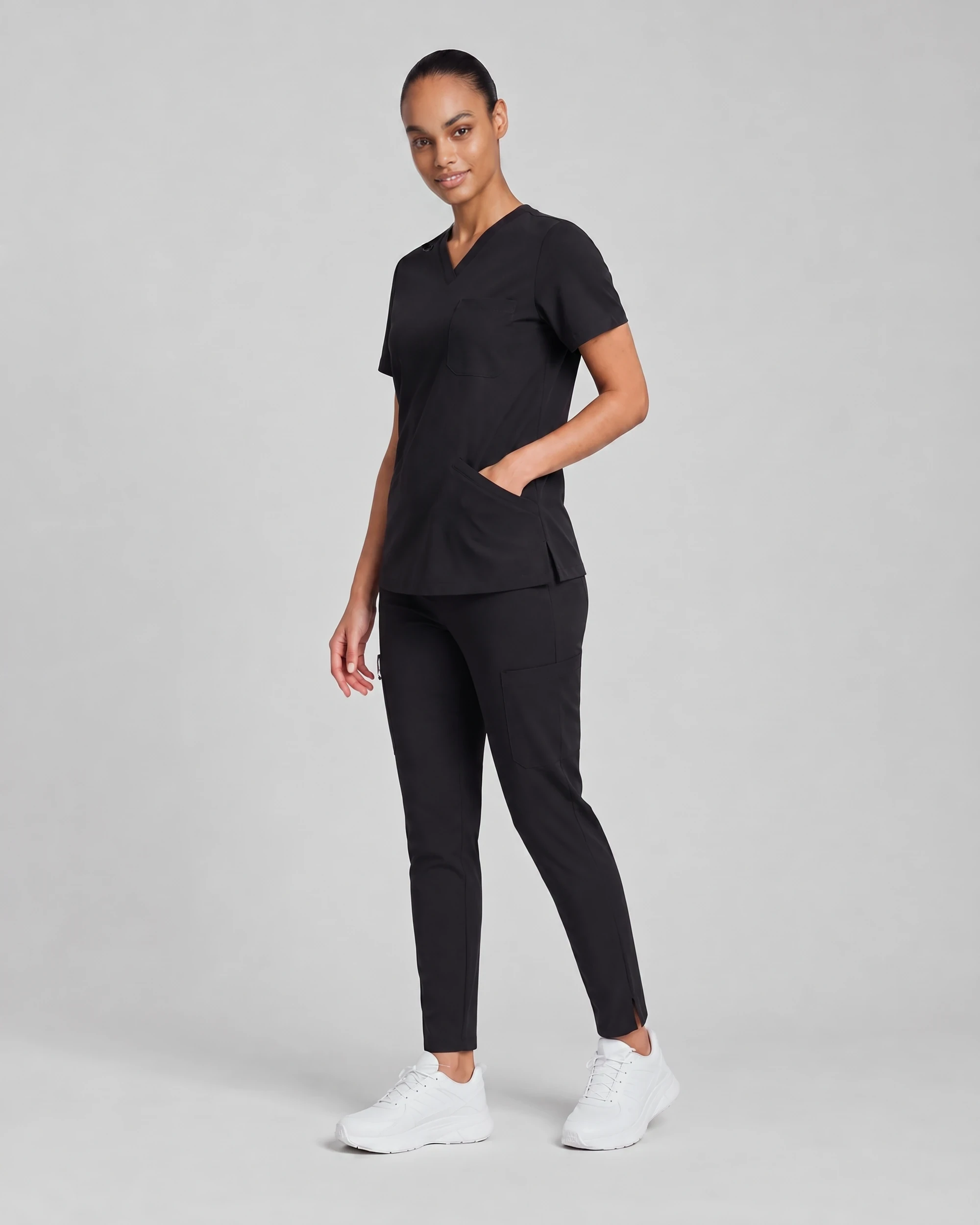
The women’s Core image shows the visible V-neck, sleeves, top length, front pocket openings, straight-leg line, side slits, and shoe interaction. It does not prove fit, coverage during movement, capacity, comfort, or shift performance.
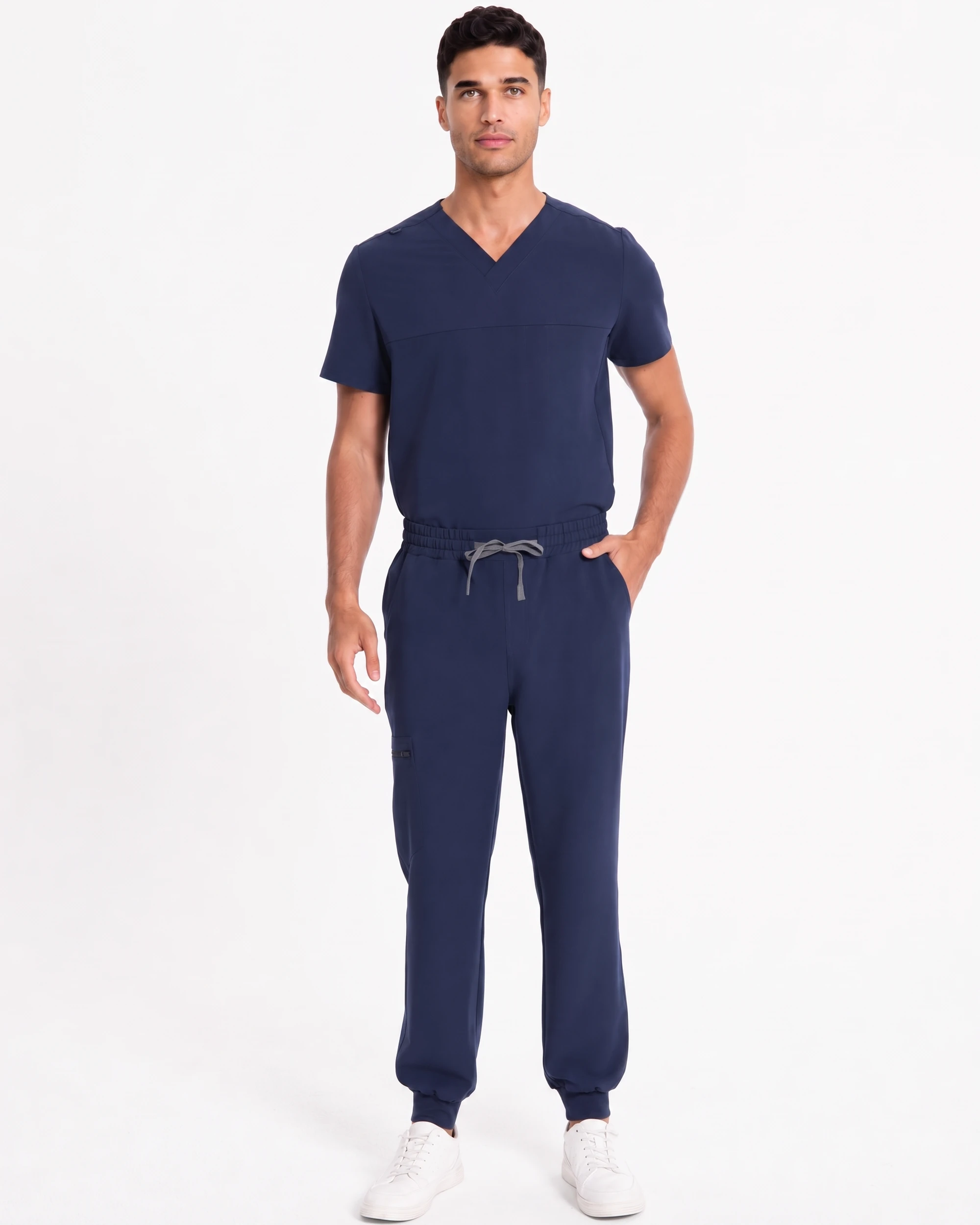
The men’s Motion image shows the visible V-neck, front waist, drawcord, tapered leg, cuffs, and shoe clearance. It does not prove movement, waistband stability, pocket function, fit, or long-shift results.
Nurse-set checkpoint: Compare current scrub sets by straight-leg or jogger shape, separate top and pant sizing, gallery details, and current order terms.
Frequently Asked Questions
What are the best scrubs for nurses who work long shifts?
Choose the pair that passes your written rules, separate top-and-pant measurements, movement screen, permitted pocket load, layer plan, and return check. A long shift does not make one silhouette or brand universally best.
How should nursing scrubs fit?
The top should maintain the coverage you need while reaching and leaning, and the pant should stay in place through sitting, standing, bending, and walking without relying on repeated adjustment. Judge the top and pant separately.
Are jogger scrubs or straight-leg scrubs better for nurses?
Neither is always better. Check workplace rules, hem interaction with shoes, seated cuff position, rise, movement, and pocket placement on the exact garment.
How many pockets should nursing scrubs have?
Use the number of workable locations required by your permitted loadout. Placement, opening, closure, reach, and what happens to the whole garment under load matter more than the headline total.
How many scrub sets does a nurse need?
Count the maximum number of shifts between laundry days, then account for employer-provided garments and a realistic backup. Confirm one set before multiplying the same size and style across a rotation.
Should I wash new scrubs before checking the fit?
No. Complete every eligible tags-on indoor check and read the current return terms first. Washing, alteration, embroidery, or tag removal can change return eligibility.