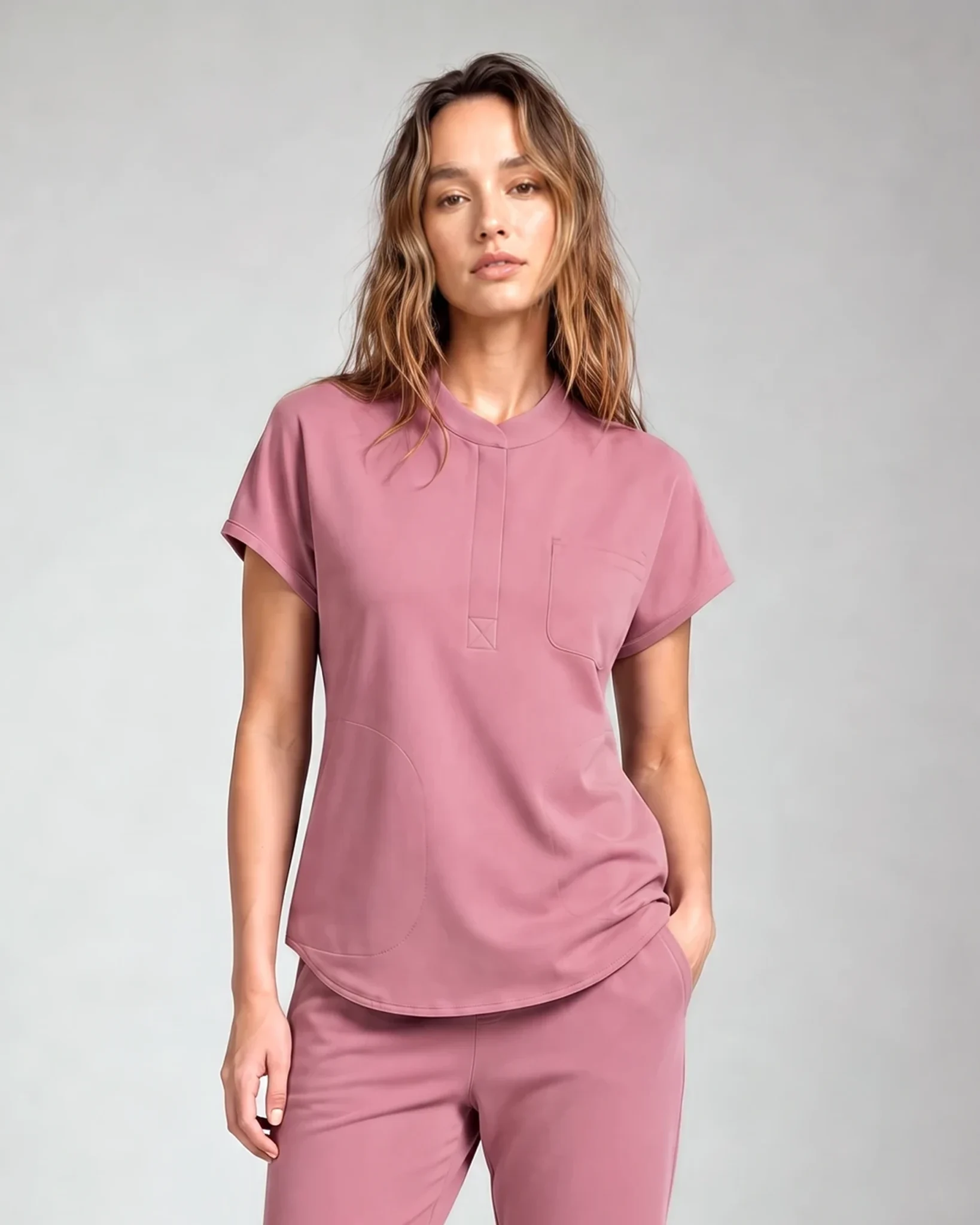

Maternity scrubs have to solve more than a growing waist. The real brief includes the required uniform color, changing top and pant fit, length, coverage, base layers, workplace tasks, return eligibility, a short use window, and whether the pieces can work after pregnancy.
As of August 26, 2026, the current LumiScrubs public catalog does not list a maternity-specific scrub product or maternity selector. LumiScrubs publishes this guide, but it does not present an ordinary Lumi set as maternity wear. This is a noncommercial planning guide, not medical advice, legal advice, or a product recommendation.
Quick answer: what should you decide first?
Write a one-page brief before looking at products. Update it whenever the fit conflict or workplace need changes.
| Decision | Question to answer | Evidence to keep |
|---|---|---|
| Uniform rule | What exact color, style, logo, layer, and footwear does the employer require? | Handbook section or written confirmation |
| Current conflict | Is the problem at the bust, abdomen, waistband, rise, seat, thigh, inseam, neckline, sleeve, or hem? | Dated measurements and a specific fit note |
| Use window | When is the item needed, and for how long is that assumption useful? | Required date and next review date |
| Work task | Which sitting, standing, bending, reaching, lifting, or other task needs separate review? | Task list and workplace or provider guidance |
| Purchase route | Maternity-specific garment, temporary accommodation, approved alternative, borrow, or secondhand? | Exact item and condition, not a generic label |
| Reversibility | Can it be returned, exchanged, altered later, or used postpartum? | Current policy and alteration record |
| Budget | What is the complete cost for the expected use window? | Garment, shipping, return, alteration, and replacement costs |
Do not buy three sizes of the same cut before naming the conflict. More width can help one area while creating a neckline, shoulder, rise, hem, or length problem somewhere else.
Workplace and safety boundaries come before style
A uniform change may be an accommodation question
The U.S. Equal Employment Opportunity Commission says possible accommodations under the Pregnant Workers Fairness Act can include changing a uniform or dress code. It also notes that a worker may need different accommodations as pregnancy progresses or after childbirth. Read the current EEOC guidance and discuss the actual situation with the employer; coverage and outcome depend on the facts.
Ask for the approved change in writing. A verbal “wear whatever fits” can leave color, logo, footwear, base-layer, and role-identification questions unresolved.
Keep scrub fit separate from other task requirements
NIOSH’s current pregnancy and physical-demands guidance directs workers to discuss job demands with their healthcare provider and workplace safety contacts.
A looser scrub top does not resolve concerns about lifting, prolonged standing, repeated bending, exposure, or other job demands. Use the employer’s process and the provider’s guidance for those questions rather than treating a clothing change as the whole answer.
Eight maternity-scrub fit checks
1. Choose the top and pant independently
Measure chest or bust, waist, hip, and intended inseam. Use the current chart for the exact product, then identify which dimension controls the top and which controls the pant.
The scrub size chart explains body versus garment measurements and split sizing. Do not use it to turn a standard product into a maternity cut.
2. Name the waistband and rise strategy
Record where the waistband sits, how it adjusts, whether the front has a panel or seam, and what happens when sitting and standing. “Stretchy” is not enough; the location and construction matter.
Avoid automatic size-up rules. A larger standard pant can add width without changing rise, front shaping, waistband placement, or length in the way you need.
3. Check the top from neckline to hem
Stand, sit, lean, reach across, and reach overhead. Watch the neckline, shoulder, upper back, armhole, side slit, front hem, and back coverage.
Extra front room should not be inferred from a loose studio pose. Check the actual garment over the permitted layer and at the point in time when it will be used.
4. Keep length separate from width
A wider size is not automatically longer in the right places or shorter at the ankle. Record rise, inseam, leg shape, hem or cuff, shoe, and whether the pant clears the floor through walking and sitting.
If a product offers length categories, confirm the exact variant. A category statement does not prove that every color, size, and length is in stock.
5. Test the real layer and temperature plan
Use only layers permitted by the workplace. Check sleeve and neckline overlap, bunching, coverage, and whether the layer changes fit at the armhole or waistband. The under-scrubs guide provides a policy-first layering checklist.
Do not treat a base layer as a fix for a uniform that no longer fits or for a work exposure that requires separate controls.
6. Limit pocket loading during the trial
List what must be carried and where it can be stored. Add items one at a time during a clean test, then sit, walk, and lean. Watch waistband displacement, hem pull, pressure points, access, and whether an item changes balance or clearance.
This is a garment-use observation, not a medical test. If carrying or lifting is part of a work restriction or accommodation, follow the relevant provider and workplace guidance.
7. Preserve the return route
Complete the measurement, layer, movement, shoe, lighting, and pocket checks before work wear, laundering, alteration, or personalization. Save the product page, selector state, policy, delivery date, packaging, and tags.
The shipping and return guide explains why item condition, personalization, order type, and return reason must be separated.
8. Plan the exit, not just the purchase
Set a review date instead of assuming one garment will work throughout pregnancy and postpartum. Decide in advance whether the piece can be adjusted, reused, resold, donated, or reassigned under the applicable hygiene and workplace rules.
Permanent employer embroidery can reduce reuse. If branding is required, record who pays, what placement is approved, and whether a removable identifier is permitted.
Compare purchase routes by short-term value
The cheapest item is not automatically the lowest-cost solution, and the highest-priced item is not automatically safer or more reusable. Compare the route that is actually available to you.
| Route | Potential advantage | Question that can change the decision |
|---|---|---|
| Maternity-specific product | Construction may be designed around changing front/waist fit | Is the required color, size, length, and return route available? |
| Approved standard alternative | May reuse an already familiar workplace product | Does the actual cut solve the named conflict without creating another? |
| Employer-provided accommodation | Can align the uniform change with policy | What is approved, for how long, and who supplies or pays? |
| Borrowed garment | Low purchase cost for a short window | Is the condition, size, color, and cleaning history acceptable? |
| Secondhand garment | Lower price and less concern about short use | Can exact identity, wear condition, alteration, and returnability be verified? |
| Temporary alteration | May target one area rather than changing every dimension | Is it reversible, approved, and safe for the garment and work setting? |
Use the expected wearable window, not a vague future lifespan. Include shipping, return postage, alteration, replacement risk, care, and postpartum reuse. If the item fails the uniform rule or cannot be returned after a clean try-on, the sticker price understates the risk.
What to ask the employer and seller
Ask the employer or uniform coordinator
- Which color name, garment type, logo, layer, shoe, and role identifier are required?
- Is a maternity garment, alternate waistband, different top/pant size, temporary color exception, or different identifier permitted?
- Does an accommodation request have a specific contact and documentation process?
- Which tasks need a separate workplace or provider review?
- Who pays for a required temporary uniform change, alteration, or replacement?
Ask the seller
- Is this product specifically designed and labeled for maternity use, or is it a standard cut?
- Are the chart values body or garment measurements, and what are the rise and inseam details?
- Which exact color/size/length variants are available now?
- What changes after laundering, alteration, or personalization under the return policy?
- Is the same product expected to remain available during the planned use window?
If a seller cannot answer, record the gap. Do not replace missing specifications with review averages or an automatic size recommendation.
Frequently asked questions
Can I just buy regular scrubs in a larger size?
Sometimes a standard cut may be an approved temporary option, but a larger label can still miss the needed rise, front shaping, waistband position, neckline, or length. Test the exact clean garment and confirm the workplace rule.
When should I buy maternity scrubs?
There is no universal week. Buy or request an accommodation when the current uniform no longer meets the documented fit, coverage, safety, or workplace need, allowing enough time for delivery and a reversible trial.
Do maternity scrubs replace a workplace accommodation?
Not necessarily. A garment purchase and an accommodation process are separate. Use current employer procedures and official guidance for the actual limitation and job.
Can one pair work through pregnancy and postpartum?
Do not assume it. Set review dates, repeat the movement and coverage checks, and plan an alteration, replacement, or reuse path if the fit changes.
What is the most important record to keep?
Keep the exact product/size/length, dated body and garment measurements, workplace approval, fit notes, policy snapshot, delivery date, and any accommodation or alteration decision.