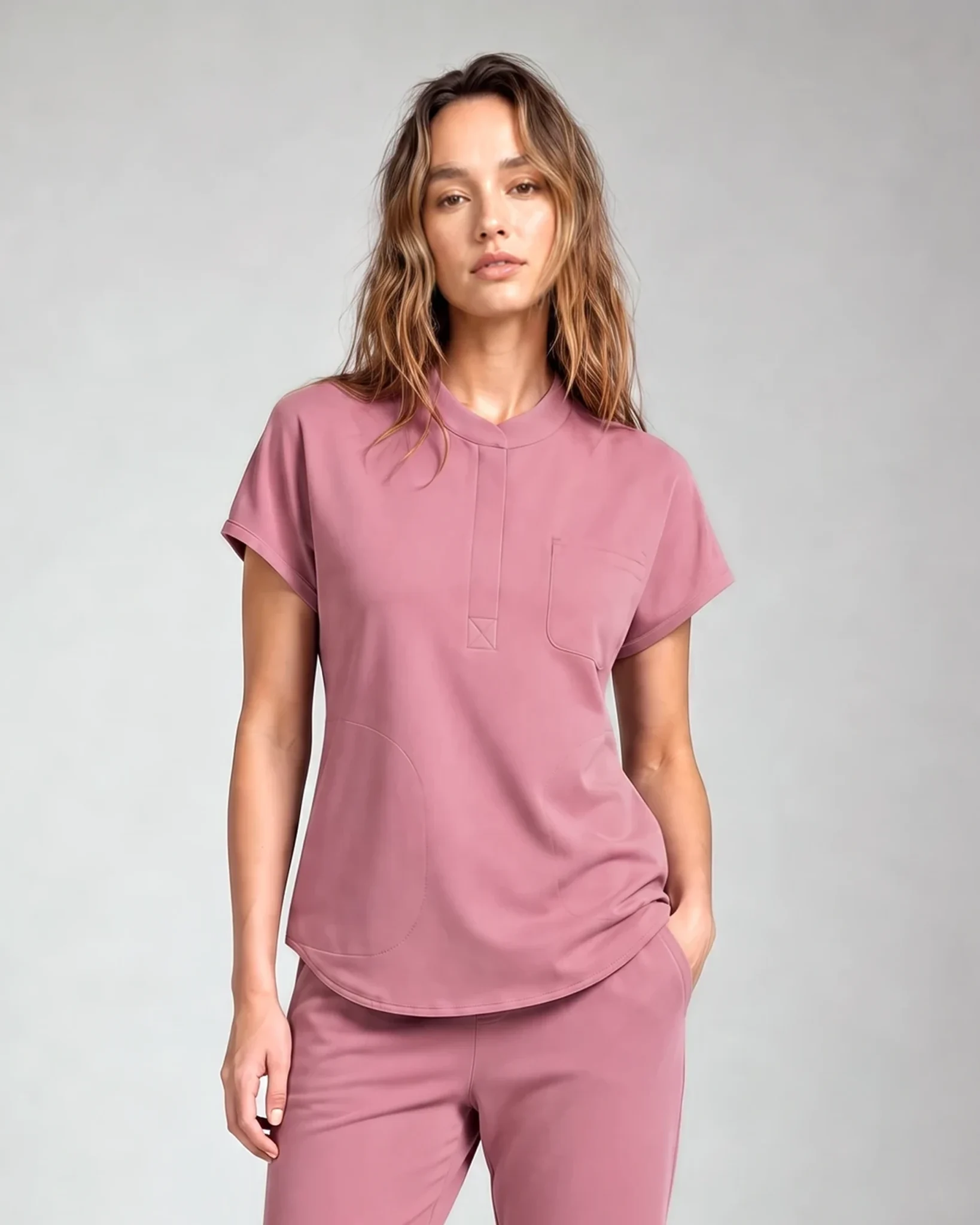

Curvy fit scrubs should be chosen by the relationship between your waist, hip, rise, and thigh room—not by the word “curvy” or a familiar letter size. If your waist and hip land in different chart bands, treat that split as a comparison problem: try the relevant sizes or cuts and record what changes. Do not assume that sizing up or down will put every part of the pant in the right place.
The seven checks below keep the decision observable. They separate waistband position, rise, hip and thigh room, inner-thigh contact, pocket interaction, and pant shape so one vague “fits well” judgment does not hide the actual problem.
1. Record the measurement split
Open the current chart for the exact brand and cut. Follow that chart’s measurement method; do not compare a body measurement with a flat-garment number as though they were the same thing.
Record at least:
- waist measurement and the chart band it reaches;
- hip measurement and the chart band it reaches;
- the size of a pant that currently fits closest to the way you want;
- the name and cut of that pant, not only its letter size;
- any area where the chart does not publish a measurement you need.
When waist and hip point to different sizes, write both results down. The chart has identified a proportion question, not answered it. A larger size may add width in several places; it does not guarantee a better rise, waistband position, thigh path, or hem.
Use the LumiScrubs fit and size guide for the current Lumi chart and cut notes. If either measurement sits outside the published range, the current Lumi line is not a chart-supported match; stretch or an unlisted size is not a substitute.
2. Check the waistband with empty pockets
Try the pant with the base layer and shoes you intend to use. Leave the tags attached and empty every pocket. Stand naturally, sit in a firm chair, lean forward, stand again, and take several steps.
Record whether the waistband:
- stays at the same front and back height;
- folds or rolls;
- creates a sharp pressure line;
- gaps when standing but presses when seated;
- drops when you stand;
- needs a drawcord adjustment after each movement.
Do the empty test first. A phone or other rigid object can change how the garment sits, and that would mix waistband fit with pocket load. If the empty waistband already moves repeatedly, adding drawcord tension may hide the symptom without explaining the proportion mismatch.
3. Separate rise from waist size
Rise describes the distance and shape between the waistband and crotch area. Judge it through position and movement rather than a single front-view mirror check.
Sit, lean forward, take a long step, and perform a comfortable squat. Note front or back pulling, bunching, dropped back coverage, a crotch seam that feels displaced, or repeated adjustment after standing. Stop any movement that causes sharp pressure.
If a larger size eases the waist but leaves the same rise symptom, the size change did not solve the original issue. Compare another cut or rise instead of repeating a blanket size-up rule.
4. Watch the hip, side seam, and thigh together
Look at the pant from the front, side, and back while standing and after sitting. The three views catch different symptoms.
During a walk, long step, seated knee lift, and comfortable squat, record:
- horizontal pull lines across the hip or upper thigh;
- a side seam that rotates forward or backward;
- a pocket mouth that spreads or changes angle;
- fabric collecting under the seat or at the top of the thigh;
- the pant leg moving up and not returning after you stand;
- any point you have to pull back into place.
These observations do not diagnose body shape or guarantee a fit fix. They identify where one size or cut differs from another, which is the information needed for an exchange or a better next trial.
5. Map inner-thigh contact without making a wear claim
Inner-thigh contact is not one universal defect. It depends on body proportions, garment ease, seam position, fabric surface, movement, layers, moisture, and time. A short clean test cannot predict a full workday or a garment’s future wear.
For the return-eligible screen, walk indoors for several minutes, sit, stand, and take a few normal steps in both directions. Write where the pant legs touch, whether a seam sits in that contact path, whether one side differs, and whether the fabric pulls before contact. Stop if there is sharp pressure, rough contact, or restricted movement.
Do not turn a smooth hand feel, stretch label, or studio photograph into a friction result. The useful output is a contact map for this body, size, cut, layer, and movement set.
6. Add one pocket item and repeat the checks
After the empty pant passes, place one clean, blunt stand-in with roughly the same dimensions and weight as a permitted everyday item in the intended pocket. Repeat the sit, stand, walk, and comfortable squat once.
Compare against the empty result:
- Did the waistband move on one side?
- Did the pocket mouth change shape?
- Did the side seam rotate?
- Did the item meet the hip crease while seated?
- Did the thigh contact path change?
- Did the pant require a new adjustment?
That comparison is a fit-and-layout screen, not a pocket-capacity or durability test. For a complete item map, use the separate scrubs-with-pockets guide.
7. Compare cut and size while the decision is reversible
Change one variable at a time. If possible, compare two adjacent sizes in the same cut before comparing two cuts. Then use the same base layer, shoes, empty-pocket sequence, one-item sequence, movements, and viewing angles.
Keep a short table:
| Trial | Waistband | Rise | Hip and thigh | Inner-thigh contact | Pocket load | Decision |
|---|---|---|---|---|---|---|
| Size A, Cut 1 | Position and adjustments | Pulling, bunching, coverage | Lines, seam rotation, return after movement | Location and seam path | Empty versus one item | Keep, exchange, or reject |
| Size B, Cut 1 | Same observations | Same observations | Same observations | Same observations | Same sequence | Keep, exchange, or reject |
| Best size, Cut 2 | Same observations | Same observations | Same observations | Same observations | Same sequence | Keep, exchange, or reject |
The current Shipping & Returns page gives eligible non-personalized items a 30-day return window when they are unworn, unwashed, and in original packaging; personalized or custom items are final sale unless defective. Read the current terms before washing, altering, embroidering, or wearing the pant to work.
The jogger-versus-straight-leg guide can help isolate cuff, hem, shoe, and lower-leg questions. This page keeps the waist, rise, hip, and thigh relationship as the primary decision.
Two current LumiScrubs cuts to inspect honestly
LumiScrubs publishes this guide and sells the two sets shown below. Product pages, size selectors, and galleries were checked on August 28, 2026. LumiScrubs has not published a curvy-specific fit trial or a body-shape outcome for either set.
The current women’s Core page pairs a V-neck top with a straight-leg pant, while the current women’s Motion page pairs a coordinated top with a tapered jogger and elasticated cuff. Both pages list women’s top sizes from 2XS through 2XL and allow top and pant sizes to be selected separately at the set price.
That gives you two cut and split-size paths, not a size recommendation for a particular waist-to-hip relationship. Neither product should be chosen from the word “curvy” alone.
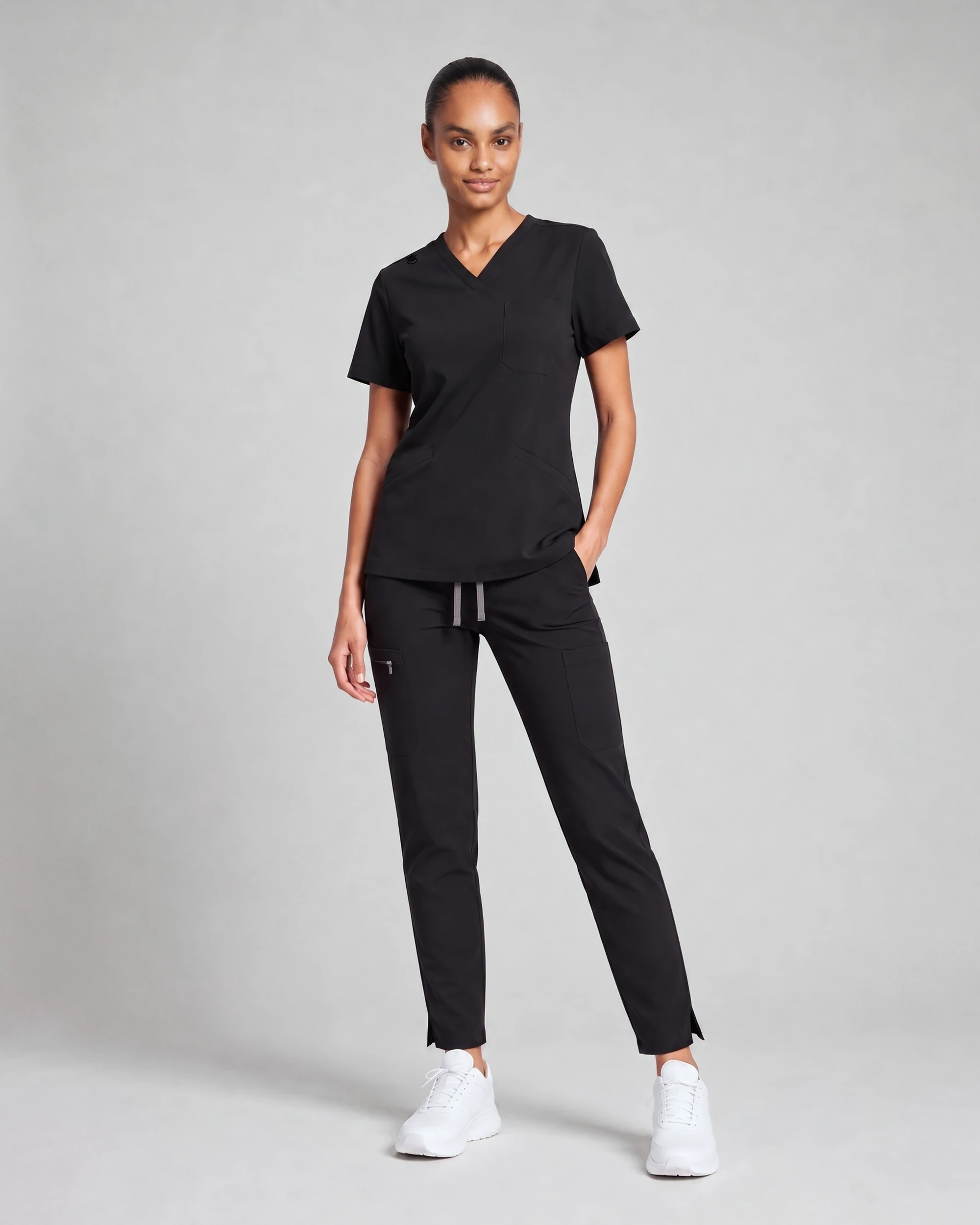
Women’s Core image: the front view shows the V-neck, visible top pockets, straight-leg outline, and ankle side slits. It does not prove size, waist-to-hip fit, rise, thigh room, contact, movement, or coverage.
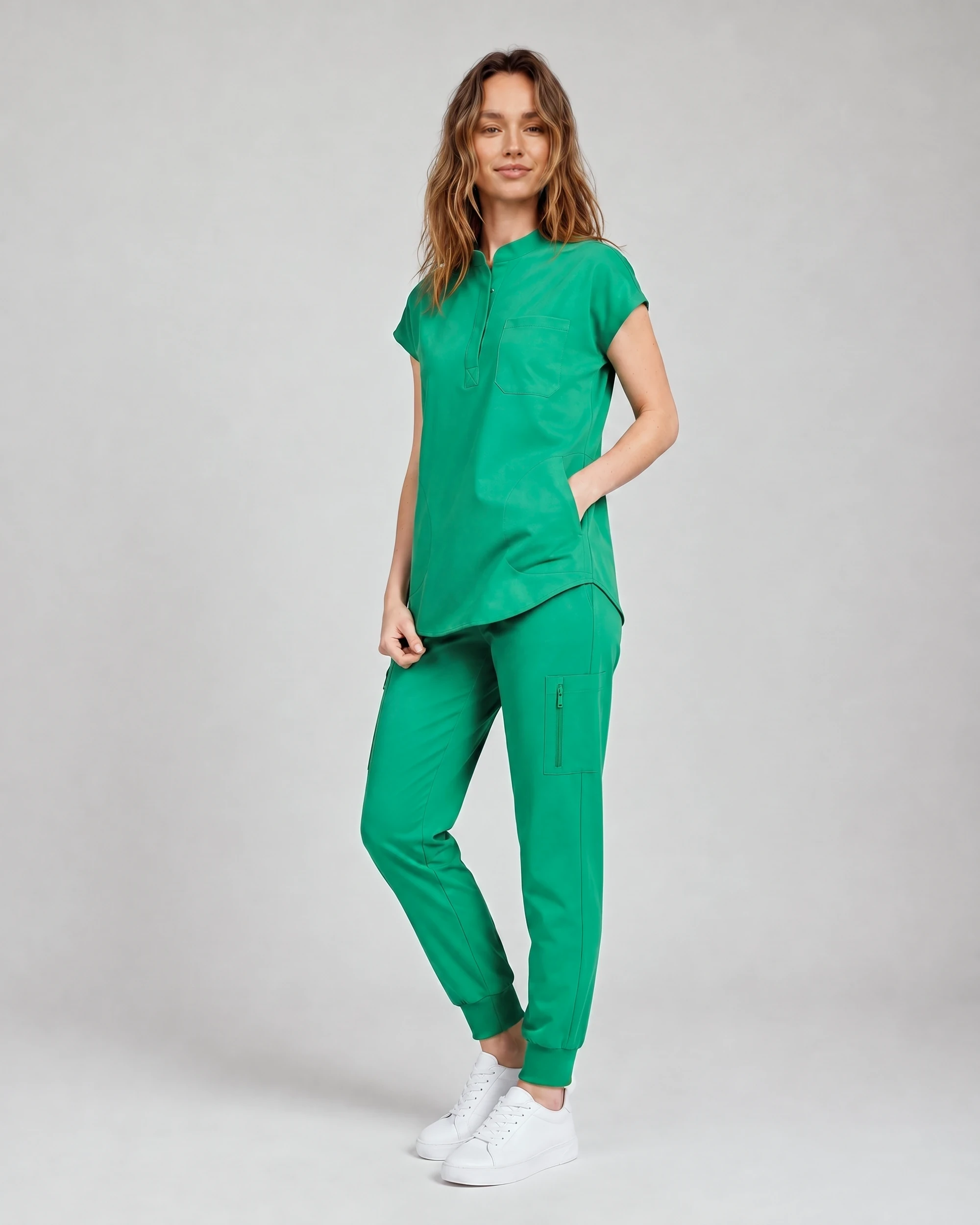
Women’s Motion image: the three-quarter view shows the top-and-jogger pairing, tapered leg, and ankle cuff. It does not prove size, waist-to-hip fit, rise, thigh room, contact, movement, or coverage.
After the measurement and clean comparison identify a workable size and cut, browse the current women’s scrub collection and verify the exact product’s selectors before ordering.
Keep a proportion-fit record
A useful reorder note is specific enough to survive a forgotten letter size:
- product and cut name;
- color and size;
- date checked;
- waist and hip chart bands;
- waistband result standing and seated;
- rise result;
- hip and thigh observations;
- inner-thigh contact path;
- empty and one-item pocket result;
- shoe and base layer;
- keep, exchange, or reject decision.
If the brand changes its pattern, size chart, inseam, waistband, fabric, or pocket layout, treat the new version as a new trial. A familiar style name is not proof that every construction detail stayed the same.
Frequently asked questions
Should curvy shoppers size up in scrub pants?
Not automatically. Compare waist and hip chart results, then test adjacent sizes or another cut while recording waistband, rise, hip, thigh, and movement changes.
Are straight-leg or jogger scrubs better for larger thighs?
Neither shape is universally better. Compare the exact cut through the thigh, knee, calf, hem or cuff, rise, and waistband using the same movements and shoes.
Can stretch solve a waist-to-hip fit difference?
Stretch describes material behavior, not where a waistband, rise, seam, or pocket will sit. Use the chart and a clean movement comparison instead of treating stretch as a fit outcome.
How can I check inner-thigh contact before work?
With tags attached, use a clean indoor walk, sit-to-stand, and comfortable squat. Record the contact location, seam path, pulling, and adjustments without treating the short test as a full-workday result.
What if my measurements are outside the current LumiScrubs chart?
Do not size down or rely on stretch to enter the listed range. Choose a seller whose current chart includes your measurements and whose exact cut can be tested under a return-eligible condition.