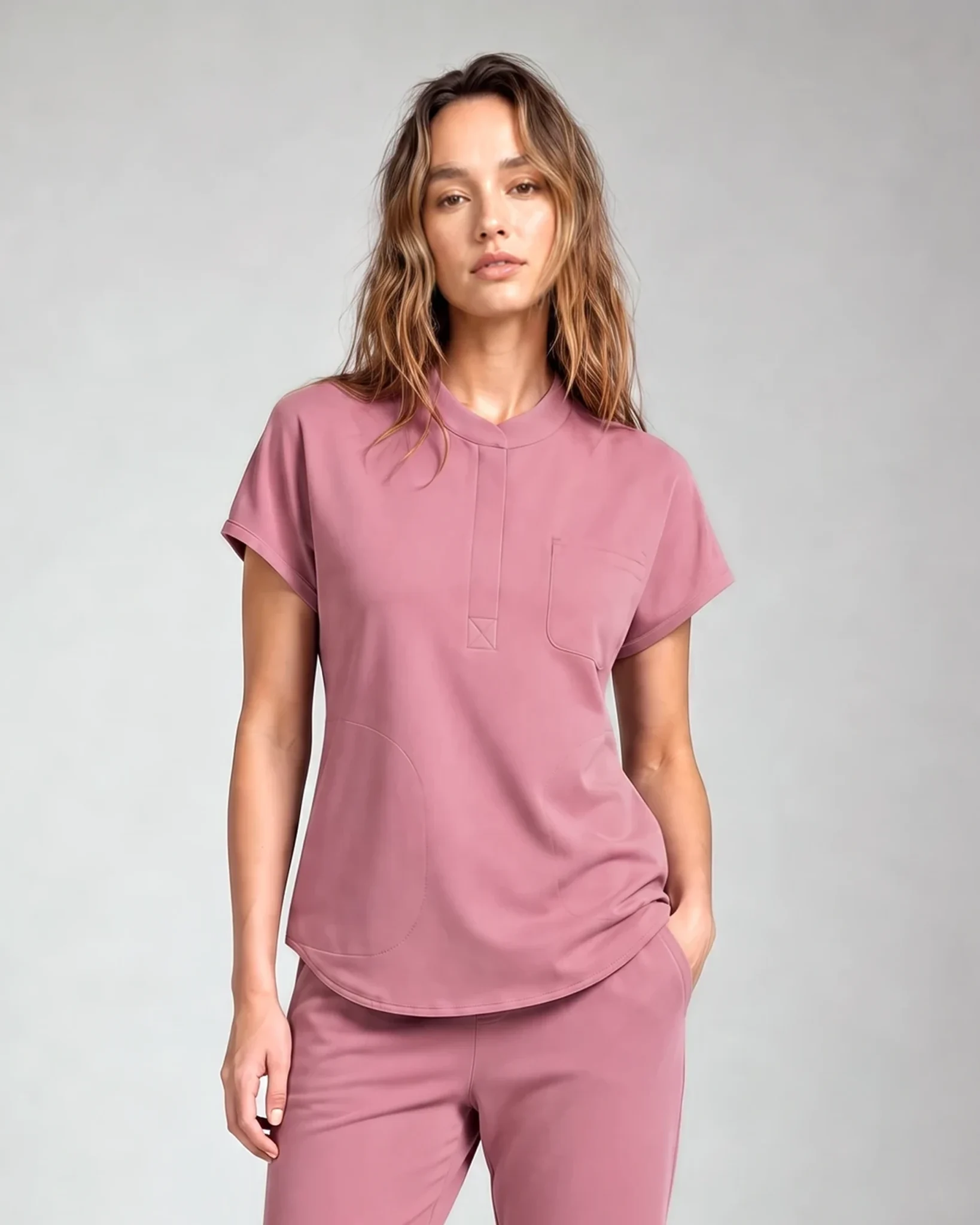

To judge scrub fit after washing, create a clean baseline before the first wash, follow the sewn-in care label, then repeat the same measurements and movement checks. Do not buy a tight size because you expect it to relax, or a large size because you expect it to shrink. A change in feel is not automatically a change in garment dimensions.
LumiScrubs publishes this guide and sells the two sets shown below. We have not published a controlled before-and-after dimensional-change study for those finished garments. Product pages, images, and return terms were checked on August 28, 2026.
The short version
| Stage | What to do | What it prevents |
|---|---|---|
| Before removing tags | Measure your body, compare the garment chart, and run an indoor movement check | Using laundry to correct a wrong starting size |
| Before first wash | Photograph the care label and measure the clean garment flat | Relying on memory |
| During care | Record wash setting, products, drying method, and heat setting | Blaming a result on an unknown routine |
| After drying | Let the garment reach a consistent dry state, then remeasure the same points | Comparing damp, warm, stretched, or folded fabric with a different baseline |
| After dressing | Repeat the same layer, shoes, pockets, and movement sequence | Confusing a garment change with a styling or load change |
There is no universal scrub shrinkage result. Fiber content, fabric construction, garment construction, care conditions, and measurement method can all differ. Your record should answer what happened to one garment under one documented routine.
1. Decide whether the unwashed fit is already wrong
Keep the tags attached and try the garment indoors with the base layer and shoes you plan to wear. Empty the pockets. Use the same mirror, lighting, and movement sequence you will use later.
For the top:
- reach both arms forward and overhead;
- cross one arm in front of the body;
- sit and lean forward;
- check the neckline and back coverage;
- note pulling at the shoulder, upper back, chest, and hem.
For the pant:
- sit for two minutes without adjusting the waist;
- stand without lifting the waistband;
- step up, squat comfortably, walk, and turn;
- check rise, seat, thigh, knee, and hem;
- note sliding, rolling, twisting, pinching, or repeated retightening.
If the garment already pinches, exposes, slides, or restricts your normal movement, washing is not a reliable correction. Compare another size or cut while the item is still eligible under the seller’s current terms.
The LumiScrubs fit and size guide owns the body-measurement and clean tags-on decision. This page starts after you have a plausible size and want a wash record.
2. Create a flat-garment baseline
Measure on a clean, flat surface. Smooth the garment without pulling it. Use the same tape, measuring direction, and landmarks every time. Record to the nearest quarter inch or half centimeter; false precision will not make an inconsistent method reliable.
Top measurement card
| Point | How to place the tape | Before wash | After wash | Difference |
|---|---|---|---|---|
| Chest width | Straight across, underarm seam to underarm seam | |||
| Shoulder width | Across the back between shoulder seam points | |||
| Body length | High shoulder point to bottom hem | |||
| Sleeve opening | Across the opening, edge to edge | |||
| Hem width | Straight across the bottom opening |
Pant measurement card
| Point | How to place the tape | Before wash | After wash | Difference |
|---|---|---|---|---|
| Relaxed waist | Across the waistband without stretching | |||
| Front rise | Crotch seam intersection to top of front waist | |||
| Hip width | Straight across at the fullest garment point | |||
| Thigh width | Across one leg just below the crotch | |||
| Inseam | Crotch seam to finished hem or cuff | |||
| Leg opening | Across the finished hem or cuff |
Take a quick photo showing the tape at each landmark. If a later measurement looks surprising, the photo helps you catch a changed starting point or tape angle.
3. Record the care conditions
The sewn-in label on the finished garment is the final instruction. Photograph it before washing. Do not transfer a routine from a scrub top to a base layer, print top, jacket, or another brand.
Use a simple wash line:
Date | wash temperature/setting | cycle | detergent or additive | dryer/air dry | heat setting | load notes
Write the machine setting you selected, not an assumed water temperature. Record any bleach, softener, stain product, dryer sheet, or pretreatment only if you actually used it. If the garment shared the load with heavy, abrasive, or lint-producing items, note that too.
Close closures and empty pockets before washing. Follow label directions about color separation, turning the item inside out, and drying. Do not add a care step because an article claims it is universally gentler.
4. Remeasure under the same conditions
Compare dry with dry. A garment measured warm from the dryer, slightly damp, stretched on a hanger, or compressed in a drawer is not in the same state as a flat room-temperature baseline.
Lay it on the same surface and repeat the same order. Do not pull a waistband farther on the second measurement. Use the same seam points and record the number even when it matches.
If one measurement changes, repeat it twice and check the photo. A shifted tape position can look like a garment change. If several related measurements move in the same direction—such as body length and sleeve opening—keep the record and repeat after the next label-directed wash before assigning a pattern.
The record describes your garment. It does not create a shrink percentage for the whole brand, color, fabric family, or size range.
5. Repeat the movement check
Flat measurements do not capture every fit result. Put on the same base layer and shoes, leave the pockets empty, and repeat the original movement sequence.
Use the table to separate likely routes:
| What changed | Measurement result | More useful next question |
|---|---|---|
| Top feels shorter | Body length also decreased | Did care conditions follow the label, and does the new length still pass reach coverage? |
| Thigh feels tighter | Flat thigh width is unchanged | Was the original cut marginal, or did the layer/body/movement condition change? |
| Waist slides | Relaxed waist is unchanged | Is the base size, rise, drawcord, or pocket load the issue? |
| Hem sits differently | Inseam is unchanged | Did shoes, cuff position, or how the pant was settled change? |
| Several measurements changed | Repeated measurements confirm it | Record the exact routine and contact the seller if you need policy guidance |
Do not diagnose every post-wash complaint as shrinkage. A different underlayer, loaded pocket, body measurement, knot, shoe, or garment-settling habit can change the feel without changing the flat measurement.
For a recurring waistband symptom, use the drawstring guide. For a broader wear record, use how long scrubs last.
6. Handle between-size and split-size decisions before washing
Choose the size that passes the clean tags-on check. Do not size up automatically for an expected wash result that has not been measured.
Prioritize the dimensions that control the movement you need. For a top, that may be shoulder, chest, back reach, or body length. For a pant, it may be rise, hip, thigh, seated waist, or inseam. If the top and pant need different sizes, use separates or a set that explicitly allows independent selection.
Alterations also need a stable baseline. Do not hem or take in an item before you have decided to keep it, checked the seller’s terms, and completed any care step your alteration professional requires.
Two current sets—and the evidence limit
The current Women’s Core Scrub Set and Women’s Motion Scrub Set were product-level in stock at $64.90 when checked. Both set pages allow separate top and pant size selection. That configuration does not prove how either finished garment changes under your wash routine.
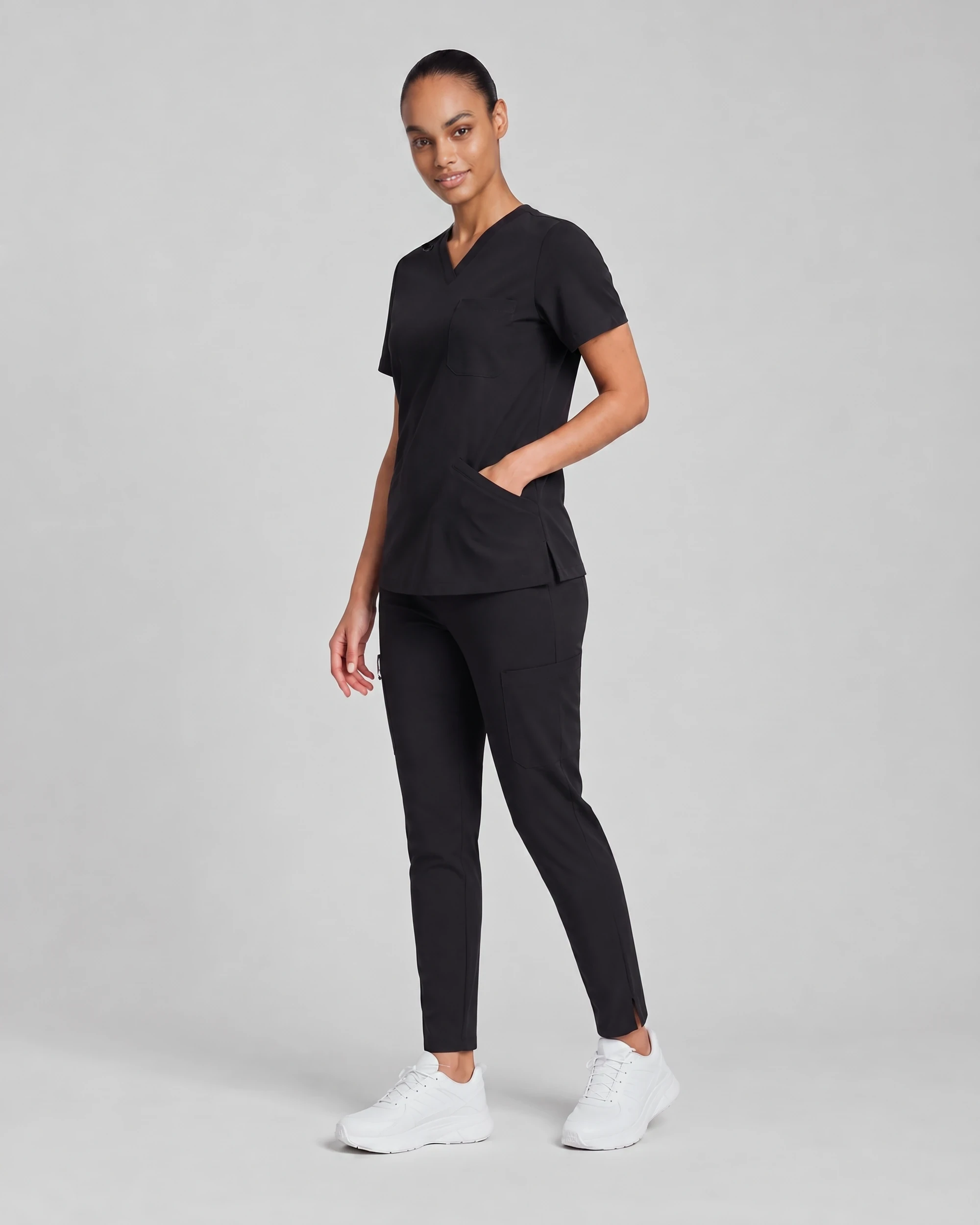
The three-quarter view shows visible neckline, top length, pocket openings, straight-leg line, side slits, and shoe interaction. It is not a dimensional-change or post-wash fit result.
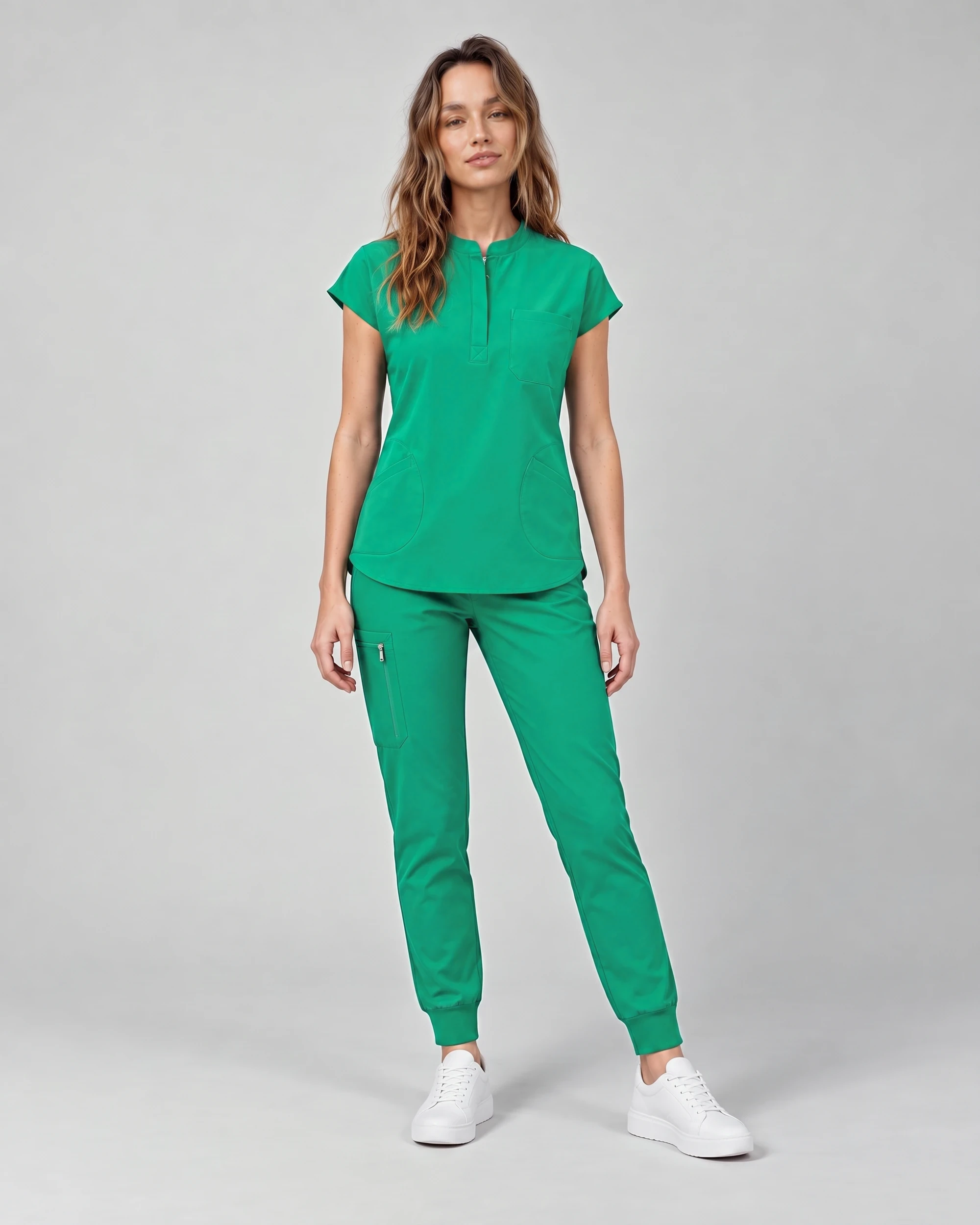
The front view shows the coordinated top, front pocket placement, tapered pant, and cuffs. It does not prove shrinkage, recovery, shape retention, or fit on another body.
If you want to compare the straight-leg and jogger routes, review both live set pages and the current scrub sets after using the measurement card. Check Shipping & Returns before washing: the current 30-day eligibility for non-personalized items requires them to be unworn, unwashed, and in original packaging.
Frequently asked questions
Do all scrubs shrink after washing?
No universal result applies to every fabric, construction, size, and care routine. Measure one garment before and after a documented label-directed wash if you need to know what changed.
Should scrubs fit loose before the first wash?
They should provide the room intended by the cut and required by your movement. Do not choose an incorrect starting size around an assumed amount of shrinkage or relaxation.
Can I return LumiScrubs after washing?
The current non-personalized return eligibility requires items to be unworn, unwashed, and in original packaging. Complete the tags-on fit decision and read the live policy before washing.
Does hot drying change scrub fit?
Use the drying method and heat level printed on the finished garment label. If fit changes, record the selected setting and compare the same flat measurements rather than applying a universal heat rule.
What if my top and pant need different sizes?
Choose separates or a set that explicitly permits independent top and pant sizing. Confirm the current selectors before checkout.