
Vet Scrubs: 6 Fit and Workday Checks
Vet scrubs should pass two tests: they must follow the exact rules of the workplace, and they must stay put through the movements, layers, shoes, and permitted pocket items of the person wearing them. Start there—not with a claim that one set is automatically best for every veterinarian or vet tech.
If you’re observing, start with the veterinarian shadowing attire guide.
LumiScrubs publishes this guide and sells the four complete sets shown below. We have not run a veterinary wear trial, animal-hair release test, claw or snag test, loaded-pocket study, chemical-protection test, or comparative durability test on them. Product and safety sources were checked on August 26, 2026.
Build a workday checklist
A small-animal exam room, a shelter, a laboratory-animal setting, and a large-animal visit do not create the same clothing decision. Even two people in one practice may have different tasks. Write the checklist before opening product tabs.
| Put this in the checklist | Ask or observe | Do not assume |
|---|---|---|
| Dress rule | Required color, approved prints, matching top and pant, visible underlayers, personalization, footwear, and who launders the garment | That a familiar scrub color is permitted |
| Task mix | Where you sit, reach, crouch, take a long step, work near the floor, or add required protective clothing | That every vet tech makes the same movements |
| Personal carry | Which personal items may stay on the body, plus their size and weight | That more pockets automatically means a better setup |
| Surface appearance | Workplace lighting, common hair or lint colors, and how quickly appearance needs to be reset | That dark fabric hides every coat color |
| Pant decision | Straight leg or jogger, required footwear, ankle clearance, and cuff pressure | That one silhouette is safer or more professional |
| First-order exit | Current return window, item condition, exclusions, and personalization rule | That an item can be washed or worn to work and still be returned |
Put workplace safety above scrub preferences
NIOSH says hazards for veterinary medicine and animal-care workers vary with the workplace setting, animal species, and task. Its veterinary hazards overview covers animal contact, lifting and restraint, chemicals, zoonoses, sharps, allergens, noise, and outdoor conditions.
The current NIOSH prevention guidance recommends a workplace-specific safety and health program, hazard identification, the hierarchy of controls, worker training, safe animal handling, infection control, and proper use of task-appropriate protective equipment.
Those requirements decide the safety plan. An ordinary scrub top or pant does not replace training, safer work processes, protective clothing, gloves, eye protection, protective footwear, respiratory protection, or other equipment selected for a specific hazard. A product photo, fabric finish, or surface-wetting result also does not prove protection from chemicals, infectious material, bites, scratches, punctures, or crushing injury.
Six checks before buying vet scrubs
1. Get the exact dress rule, not the remembered version
Ask for the current written rule or a direct answer from the person who enforces it. Record the allowed color and print, whether top and pant must match, whether joggers are permitted, what can be worn underneath, and whether names or logos require approval.
If a practice uses color to separate roles, copy the exact assigned shade. “Blue” is not a product code. The scrub color guide can help organize the questions, but it cannot replace a local answer.
2. Build a clean movement test from your own tasks
Keep the tags attached. Wear the permitted base layer and shoes, then repeat the positions from the checklist: reach forward and sideways, cross the arms, sit, crouch, perform a controlled squat, take a long step, and stand again.
At the top, check the neckline, shoulder, upper back, armhole, sleeve, and hem. At the pant, check the waistband, rise, back coverage, seat, thigh, knee, and ankle opening. Note every adjustment. Repeated readjustment gives a clearer answer than a generic stretch label.
Use the current Fit & Size Help chart for the starting size. If the trial exposes pressure or coverage problems, compare the next size and another cut. Do not apply a blanket “size up” rule without naming what needs to change.
3. Test pocket interaction, not just pocket count
List the personal items your workplace permits you to carry. For a tags-on home test, use clean stand-ins with similar dimensions and weight.
Walk, sit, crouch, reach, and stand from a low position. Record access hand, closure, body pressure, garment pulling, and retention. A phone staged in a photograph shows pocket location; it does not establish capacity, retention, or permission to carry one during work.
4. Treat animal hair as a visibility and removal question
There is no single color that hides light and dark hair at the same time. Dark hair may stand out on a light garment; pale hair may stand out on black or navy. A print may break up the visual field, but that is not evidence that hair releases more easily.
If the return terms allow a clean test, use a few removable fibers under normal workplace lighting and record visibility before removal. Treat any hair-release promise as unverified unless the seller provides a relevant test method, sample, result, and limitation.
5. Compare straight legs and joggers with the required shoes
A straight leg leaves an open hem over the shoe; a jogger narrows to an ankle cuff. Try each permitted shape with your work shoes and socks. Check clearance, cuff pressure, rise, knee room, rotation, and repeated adjustment.
Neither shape wins by job title. The useful answer is whether that exact cut works with your dress rule, footwear, body measurements, and repeated positions. The jogger-versus-straight-leg guide isolates that decision without turning it into a veterinary-performance claim.
6. Make the first order reversible
Order one set in the construction that survived the checklist. Before washing, personalization, or work wear, repeat the clean trial and inspect the front and back in bright light. Keep the tags and packaging in the condition the seller requires.
The current LumiScrubs Shipping & Returns page gives eligible non-personalized items a 30-day return window when they are unworn, unwashed, and in original packaging; personalized or custom items are final sale unless defective. Read the current terms before altering or laundering the garment.
Four current construction paths from LumiScrubs
These options are not veterinary-performance rankings. They compare straight-leg and jogger constructions in women’s and men’s sizing.
| Current set | Top and pant construction | What the clean trial should compare |
|---|---|---|
| Women’s Core Scrub Set | Three-pocket V-neck top; nine-pocket straight-leg pant | Neckline and hem position, straight-leg clearance, pocket access, and separate top/pant size choice |
| Women’s Motion Scrub Set | Coordinated top; tapered jogger with an elasticated cuff | Top length, cuff pressure, ankle fit, and separate top/pant size choice |
| Men’s Core Scrub Set | Four-pocket V-neck top; nine-pocket straight-leg pant | Neckline and hem position, straight-leg clearance, pocket access, and separate top/pant size choice |
| Men’s Motion Scrub Set | V-neck top; tapered jogger with an elasticated cuff | Neckline position, cuff pressure, ankle fit, and separate top/pant size choice |
Current product-page facts: the women’s Core set pairs a three-pocket V-neck top with a nine-pocket straight-leg pant; the men’s Core set pairs a four-pocket V-neck top with a nine-pocket straight-leg pant. The women’s Motion set pairs a coordinated top with a tapered, cuffed jogger; the men’s Motion set pairs a V-neck top with a tapered, cuffed jogger.
The current product pages list all four sets at $64.90 and allow top and pant sizes to be chosen separately at the set price. Price, pocket count, and pant shape do not establish protection, hair release, fit, or durability in veterinary work.
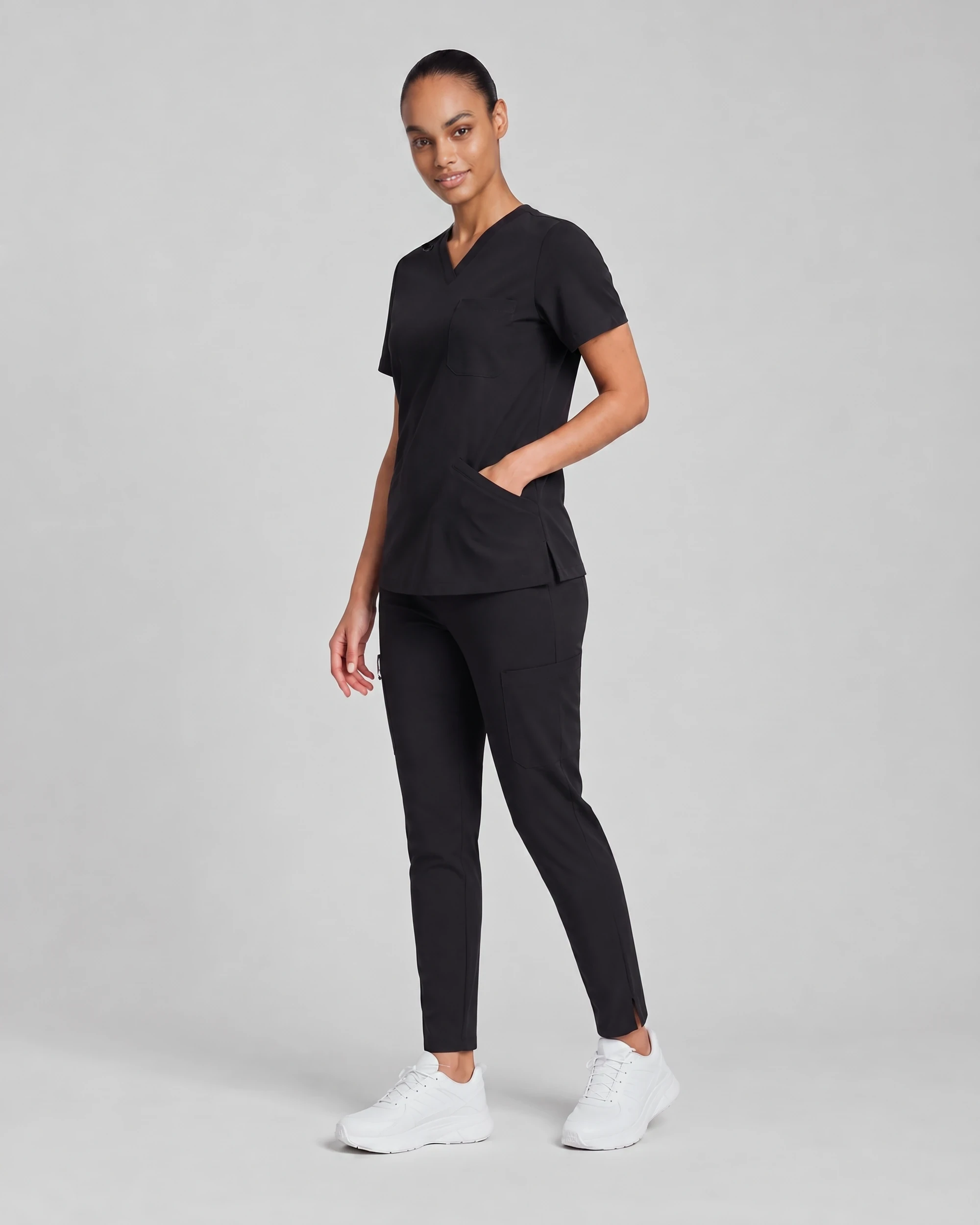
Women’s Core image: the V-neck, visible top pockets, straight-leg silhouette, and ankle side slit can be inspected. The photo does not prove fit, movement, pocket capacity, hair release, protection, or durability.
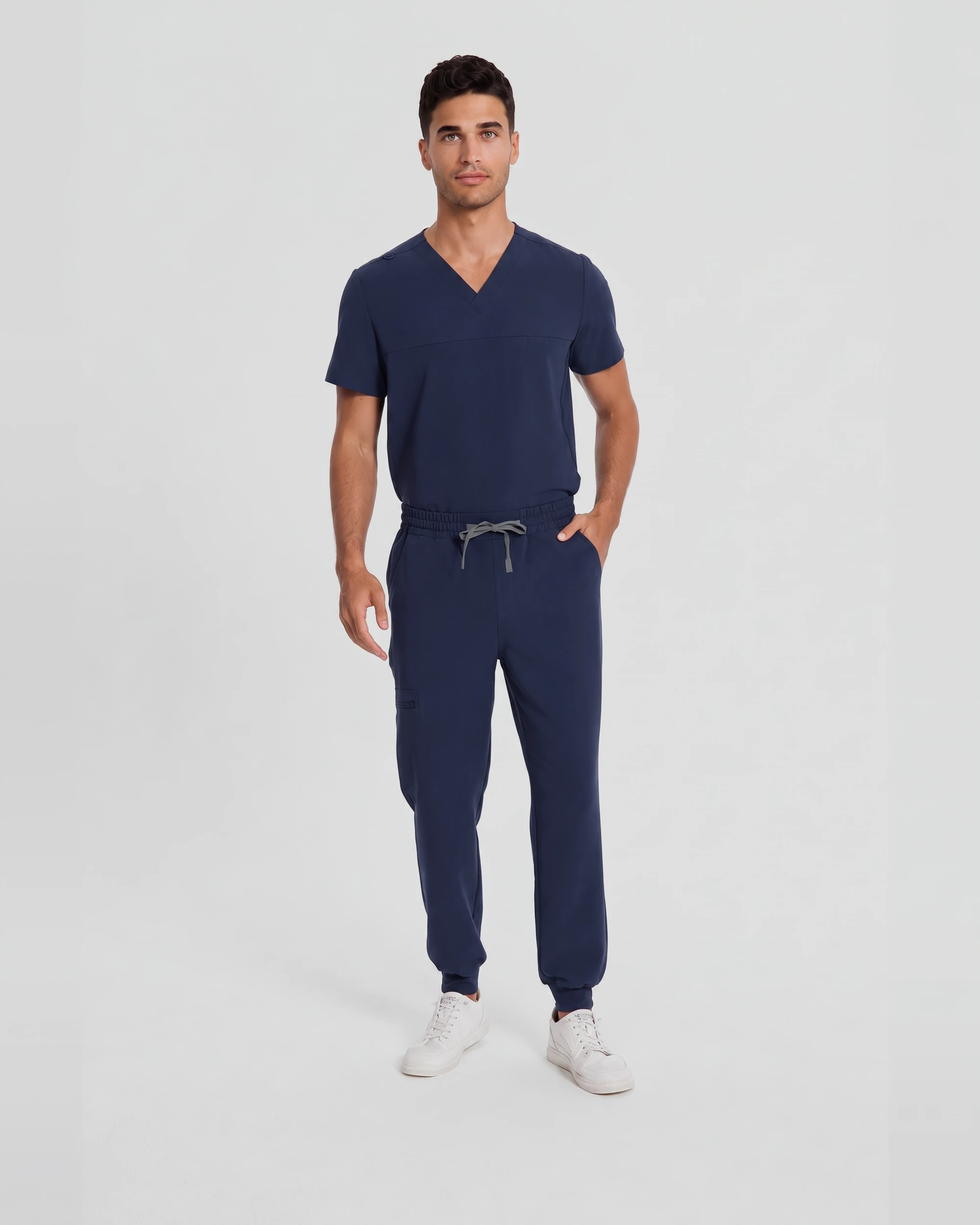
Men’s Motion image: the V-neck, drawcord waistband, tapered leg, and ankle cuff can be inspected. The photo does not prove fit, range of motion, pocket retention, hair release, protection, or durability.
After the checklist narrows the construction, browse the current veterinary scrub collection and choose one set for the clean trial.
Keep a one-set trial card
| Record | What to write down |
|---|---|
| Rule | Exact color or print, matching requirement, pant shape, underlayer, footwear, personalization, and laundering owner |
| Movements | Reaches, seated position, crouch, squat, long step, and low-to-high transition used in your own task mix |
| Top | Neckline, shoulder, upper back, armhole, sleeve, hem, and each adjustment |
| Pant | Waistband, rise, back coverage, seat, thigh, knee, hem or cuff, shoe interaction, and each adjustment |
| Pockets | Safe stand-in, location, opening, closure, access hand, pressure, pulling, and retention |
| Surface | Hair or lint color, garment color, lighting, visibility, removal method, and observed result |
| Decision | Keep, exchange size, change cut, change color, or stop because the option conflicts with policy |
Use the best veterinary scrubs comparison when you want the evidence-audit method behind these checks. This page owns the role checklist; the collection owns product browsing.
Frequently asked questions
What color scrubs do vet techs wear?
There is no universal color. Use the current rule for the exact practice, department, school, shelter, or animal-care setting. Confirm the shade and whether the top and pant must match before ordering.
Do any scrubs keep pet hair off?
Do not infer that from a color, print, smooth photograph, or broad fabric adjective. Ask for a relevant hair-release or adhesion test with its method and limits. Otherwise, test visibility and removal honestly.
Are jogger scrubs good for vet techs?
They can be a candidate when the workplace permits cuffs. Compare cuff pressure, ankle fit, rise, knee room, footwear interaction, and repeated adjustment against a straight-leg option. The job title alone does not decide.
Can ordinary scrubs protect against scratches or chemicals?
Do not use ordinary scrubs as proof of protection. Follow the workplace hazard assessment, training, safer work processes, and the protective clothing and equipment selected for the exact task.
How many scrub sets does a vet tech need?
There is no universal number. Calculate from scheduled shifts, who launders the garments, drying time, change-of-clothing rules, employer-provided items, and the need for a clean backup.