
Best Dental Scrubs: 7 Team Checks, 6 Current Options
The best dental scrubs are not a single winning style. For a practice, the better choice is a repeatable uniform system: it follows the written dress code and required garment rules, fits each person, works through the positions they actually use, and can be replaced without guesswork. Pilot a few clean outfits before placing a team order.
LumiScrubs publishes this guide and sells all six options below. We have not run a dental-team wear trial, chairside movement comparison, loaded-pocket test, opacity ranking, comfort study, color-match audit, laundering study, or durability ranking on them. This page does not use stars or internal performance scores. Product, policy, and safety sources were checked on August 26, 2026.
Replace the leaderboard with a practice brief
“Best” changes when the job changes. Dental office scrubs are a shopping category, not a complete requirement. Scrubs for dentists, hygienists, assistants, sterilization workers, and front-desk team members may share a color without sharing every garment or safety requirement.
| Decision | Write down before shopping | Prove in a clean pilot |
|---|---|---|
| Practice identity | Exact color, product code, approved neckline and pant shape, visible layers, shoes, and logo rule | The complete outfit is consistent in reception, corridors, and assigned work areas |
| Individual fit | Current garment measurements and separate top/pant sizes | Sitting, leaning, reaching, standing, walking, and squatting without repeated adjustment |
| Role boundary | Assigned areas, tasks, task-specific garment rule, and change point | Ordinary apparel stays separate from the workplace controls required for the task |
| Pockets | Permitted personal items and where they may be carried | Access, pressure, pulling, opening, and retention with clean, safe stand-ins |
| Rollout | Pilot group, return window, personalization approval, and replacement record | Enough evidence to keep, exchange, change the brief, or stop |
A team purchase should end with a short record, not a score that hides why one option was accepted and another was not.
Get task requirements from the practice
The practice’s written procedures determine the controls and garment changes required for each task. Ask for those instructions before choosing the base uniform or building a team comparison.
A neckline, sleeve, color, fiber percentage, surface-finish statement, or product name does not establish suitability for a task. Use the workplace process for those decisions, not a retail feature or styled image.
This guide does not decide where a task-specific garment is added, changed, or removed, or how used workwear should be handled. Follow the current workplace procedure rather than a product photo or buying table.
Seven checks before a dental team order
1. Map roles, rooms, and change points
List every role included in the order, the areas each person enters, and the tasks that may change the garment requirement. Reception and patient-care areas may share a visual identity while needing different written rules.
Mark the point where a task-specific garment is added, removed, or changed. Keep that line out of the apparel comparison: a scrub style cannot erase it.
2. Freeze the uniform specification
Record the exact style name, product code, named color, neckline, sleeve, pant silhouette, shoe rule, permitted layer, and personalization standard. “Navy scrubs” is not enough information for a later replacement order.
Use the scrub color guide to discuss visual choices, then let the written practice rule settle the decision. Color does not prove role, authority, calmness, cleanliness, or task suitability.
3. Fit the person, not the group average
Measure a well-fitting top and pant laid flat, then compare each with the current Fit & Size Help and product chart. Top and pant are separate decisions even when a set is sold at one price.
Do not issue one automatic size-up rule to the team. A neckline problem, upper-back pull, tight thigh, short rise, or long inseam points to a specific dimension; changing the size may fix one point and create another.
4. Test the positions used in that role
Run the pilot in clean indoor conditions with tags attached. Sit for several minutes, lean forward, reach across and overhead, rotate, stand, walk, take a long step, and perform a controlled squat. Check neckline shift, back and side coverage, sleeve contact, hem lift, waist pressure, rise, seat, thigh, and ankle opening.
The dental assistant guide focuses on repeated chairside positions. The dental hygienist guide focuses on seated-forward fit. Use the role-specific test instead of assuming one movement list covers everyone.
5. Test pocket position with safe stand-ins
First decide which personal items the workplace permits on the body. Then use clean stand-ins of similar size and weight while standing, seated, leaning, and walking. Record access, pressure, garment pull, pocket opening, and whether the item shifts.
Pocket count alone cannot answer that test. A photo can show location and construction, but it cannot prove capacity, retention, access, comfort, or permission to carry an item already used at work.
6. Approve color and personalization before volume
View the complete sample under the lighting used in reception and assigned work areas. Inspect the top and pant together. Do not promise that separate orders will match from a color name alone; keep the exact product and color identities in the practice record.
If the practice adds a logo or name, approve the file, spelling, placement, thread choice, and proof first. The embroidery guide explains authorization, permanence, and return consequences. Do not personalize a garment that has not passed fit and policy review.
7. Make the pilot reversible
Choose a small pilot that represents more than one body shape and role. Repeat the movement, lighting, layer, shoe, and pocket checks before work wear or laundering. Record exchanges and failures instead of quietly forcing the closest size.
LumiScrubs’ Shipping & Returns currently gives eligible non-personalized items a 30-day window when they are unworn, unwashed, and in original packaging; personalized items are final sale unless defective. Read the complete current terms before removing tags or approving embroidery.
Six current LumiScrubs construction paths
These products are not ranked for dental work. The table shows construction facts a buyer can verify before choosing which styles deserve a pilot.
| Option | Current configuration | Useful comparison point |
|---|---|---|
| Women’s Core Scrub Set | Three-pocket V-neck top; nine-pocket straight-leg pant | Complete women’s straight-leg set; separate top/pant sizes |
| Women’s Motion Scrub Set | Coordinated top; tapered jogger pant with cuff | Complete women’s jogger set; separate top/pant sizes |
| Men’s Core Scrub Set | Four-pocket V-neck top; nine-pocket straight-leg pant | Complete men’s straight-leg set; separate top/pant sizes |
| Women’s Chairside Zip Top | Top only; front zip and short sleeves | Zip-front alternative; pants sold separately |
| Women’s Front Desk Collar Top | Top only; collared neckline and short sleeves | Collar-neck alternative; pants sold separately |
| Women’s Soft Crew Top | Top only; crew neckline and short sleeves | Crew-neck alternative; pants sold separately |
The three complete sets were each listed at $64.90 when checked and allow separate top and pant size selection at the set price. The Chairside Zip and Front Desk Collar tops were each $34.90; the Soft Crew Top was $32.90. Price and configuration do not prove dental-role fit, movement, opacity, comfort, or durability.
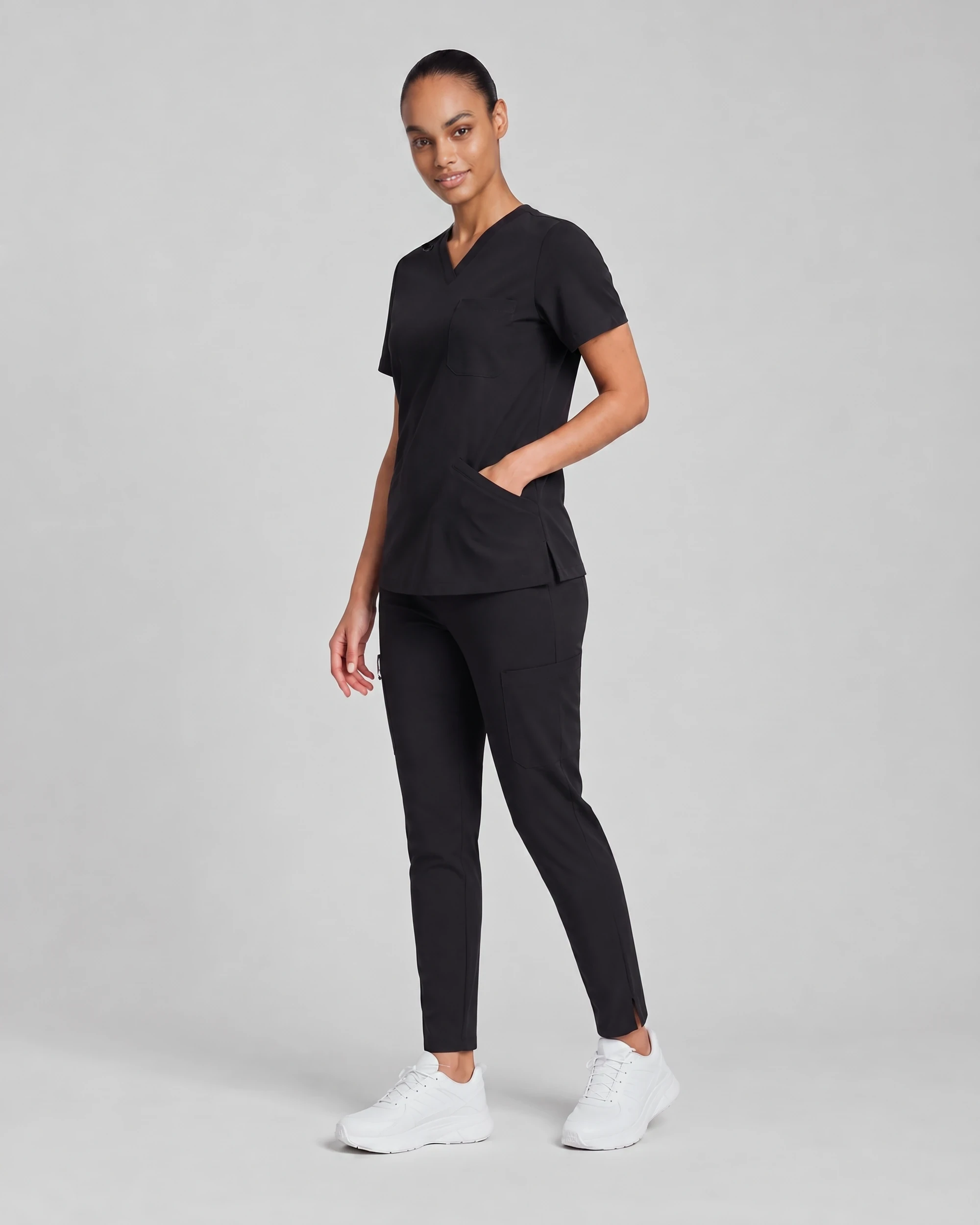
Core image: the three-quarter view shows the V-neck, visible top pockets, straight-leg outline, pant cargo pocket, and ankle slit. It does not prove team fit, opacity, movement, pocket capacity, comfort, or durability.
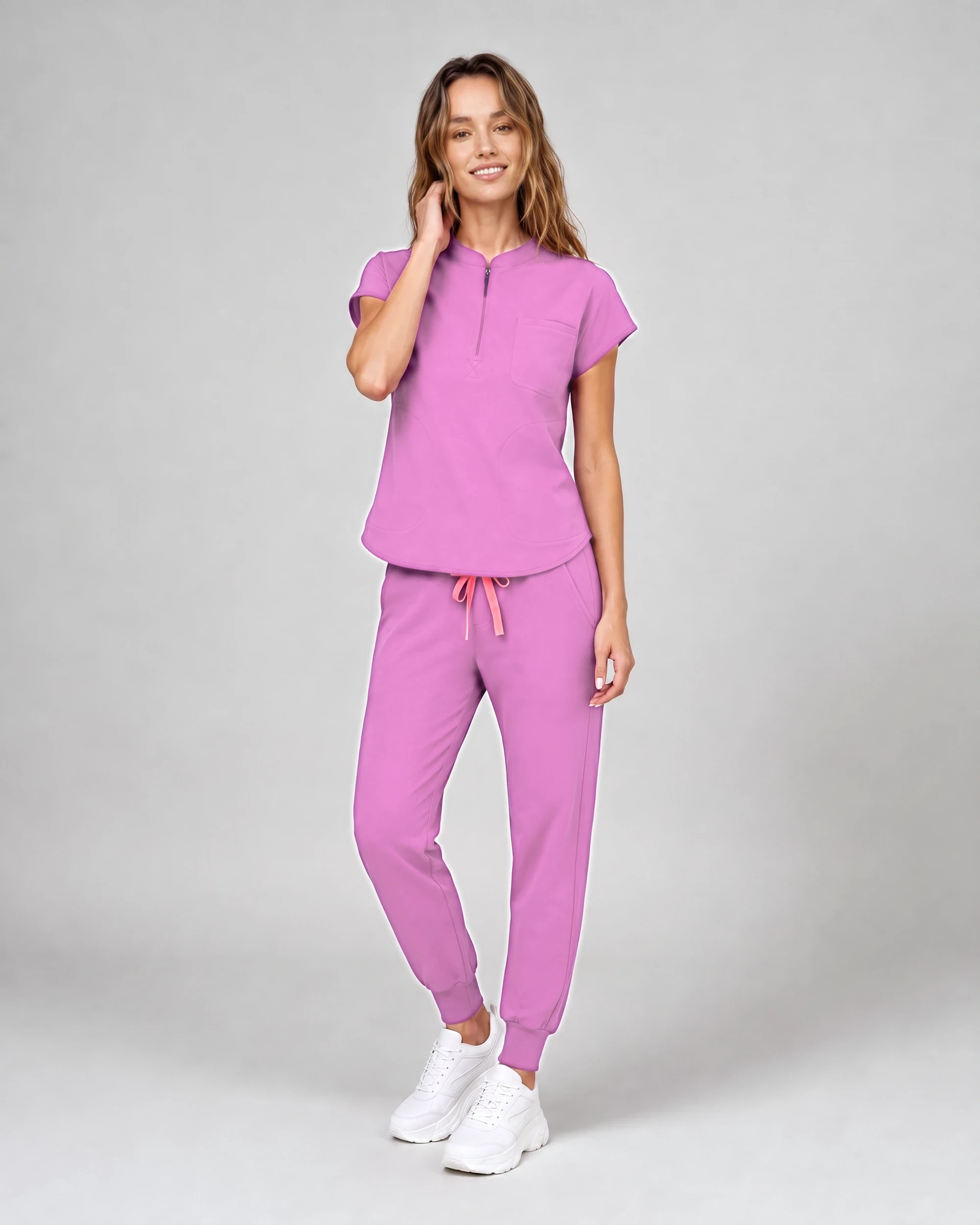
Chairside image: the front view shows the zip-front construction, short sleeves, hem, and visible pocket locations. It does not prove chairside suitability, fit, movement, capacity, retention, comfort, or durability; the styled pants are sold separately.
After the brief and pilot are ready, browse the current dental scrub options and compare only the constructions that meet the written requirement.
Keep a one-page team decision record
| Field | Record |
|---|---|
| Uniform brief | Role, area, product code, color, neckline, pant shape, layer, shoes, and logo rule |
| Individual fit | Top/pant sizes and findings at neckline, back, armhole, hem, waist, rise, seat, thigh, and ankle |
| Role trial | Positions tested, layer and footwear used, adjustments observed, and result |
| Pocket trial | Permitted stand-in, location, access, pressure, pull, opening, and retention |
| Workplace boundary | Task controls and garment-change rules recorded separately from the scrub choice |
| Rollout result | Keep, exchange, change style/color/layer, retest, or stop |
| Replacement identity | Exact style, product code, named color, size by garment, and personalization proof |
This record makes a later hire or replacement order easier to audit. It also keeps dental team uniforms consistent without pretending that every person needs the same cut, and shows when the practice needs another size or construction instead of another slogan.
Frequently asked questions
What are the best dental scrubs for a whole practice?
There is no universal winner. Start with the practice’s role, color, fit, layer, footwear, personalization, and safety rules; then pilot the exact garments across representative people and tasks.
Should dentists and dental assistants wear the same scrub color?
That is a practice decision. One color may create consistency, while different colors may support local role identification. Record the rule and exact product/color identity; do not assign job meaning from color alone.
Can a retail scrub feature settle a task-safety decision?
No. The task and workplace procedure determine the required controls and garment changes. A garment name, color, sleeve, or surface claim is not a substitute.
How many scrub sets should each employee have?
Calculate from scheduled scrub-wearing days, the laundering turnaround, emergency changes, workplace storage, and replacement access. A fixed number without those inputs is guesswork.
Should a dental practice order one style for everyone?
Only if the same style passes policy and fit review for every included person. A shared color or logo can create a team identity without forcing one neckline, pant shape, or top/pant size combination on every body.