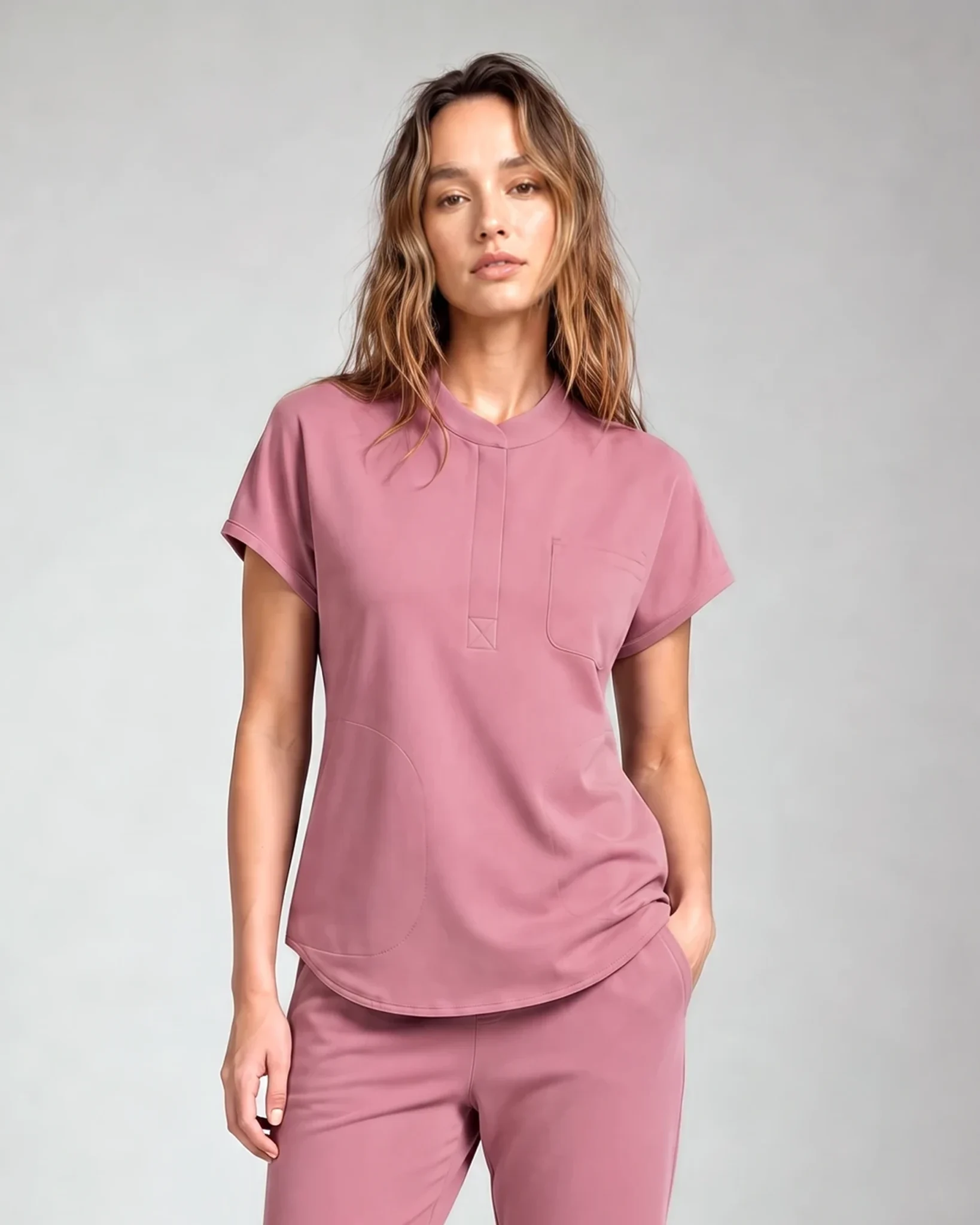

Med Spa Scrubs: A Room-to-Room Uniform Guide
Med spa scrubs have to do more than look convincing in a product photo. A useful choice follows the practice’s written rule, works along the wearer’s actual route from reception to service room, and passes a clean trial in the lighting, layers, shoes, and positions of the job.
LumiScrubs publishes this guide and sells every product linked below. We have not run a med-spa wear trial, client-perception study, opacity test, loaded-pocket test, color-match audit, thermal study, or comparative durability trial on these pieces. Product, policy, and workplace-safety sources were checked on August 26, 2026.
Start with the day, not the mood board
“Med spa team” is not one job. Someone may work at reception, sit through consultations, restock a room, assist with setup, handle checkout, or move among several areas. Another employee may never leave the front of house. The requirements sheet should reflect those differences without inventing a fashion rule for every title.
Before choosing a color or neckline, write a one-page route map:
| Record | What to confirm |
|---|---|
| Role and rooms | Where the person works, which tasks happen there, and when the outfit or required protective clothing changes |
| Uniform rule | Exact color, matching requirement, allowed neckline, pant shape, visible layers, footwear, badge or logo placement, and laundering owner |
| Repeated positions | Sitting, leaning, side reach, overhead reach, long step, squat, walking, and standing for the actual appointment flow |
| Personal carry | Which personal items may remain on the body and where approved work items are stored |
| First-order exit | Return window, item condition, return cost, and whether personalization removes the return option |
This turns “polished” or “spa-like” into something the team can approve: a written color, a named product, a consistent silhouette, a visible identifier, and a fit trial. Appearance is a local business decision, not a garment performance result.
Keep the uniform separate from the safety plan
The current OSHA workplace-equipment overview says that when engineering, work-practice, and administrative controls do not provide enough protection, employers must provide appropriate protective equipment and train workers who are required to use it.
Ordinary scrub tops and pants are a uniform layer. Their color, neckline, sleeve, fabric ratio, or surface finish does not prove protection from chemicals, blood or body fluids, sharps, heat, intense light sources, or another workplace exposure. The employer’s hazard assessment, service instructions, safety data, training, and task-specific controls decide what is required.
Two people wearing the same scrubs may perform different tasks. A clothing guide cannot widen a worker’s scope, replace protective clothing and equipment, or settle a licensing question.
Seven checks before choosing scrubs for a med spa
1. Get the rule from the person who enforces it
Ask for the current rule in writing. “Neutral colors” is incomplete; record the approved names or product codes. Confirm matching, joggers, visible underlayers, and where a badge, name, role, or logo must appear.
If color is used to distinguish roles, keep a separate identifier in the plan. Lighting, distance, and similar shades can make color alone an unreliable cue. The scrub color guide can organize the conversation, but it cannot approve a shade for a particular practice.
2. Walk the real route in a tags-on trial
Put on the permitted base layer and work shoes. Sit at a desk, lean forward, reach sideways and overhead, take a long step, perform a controlled squat, and stand again. For a room-to-room role, repeat the sequence after several minutes of sitting and walking.
Note neckline shift, shoulder or upper-back pull, sleeve contact, hem lift, waistband pressure, rise, back coverage, thigh and knee room, hem or cuff, shoe interaction, and every adjustment. Use Fit & Size Help for the starting size. Compare another size or cut only when the notes show what needs to change.
3. Test the complete outfit under every relevant light
View the exact top, pant, and underlayer in daylight, reception lighting, and the brightest room where that uniform is permitted. Check front, side, and back while standing, seated, and leaning. A studio image cannot answer how a light color, close fit, or contrasting base layer will look elsewhere.
Check top-to-pant coordination too. A shared color name does not prove that separate products or later orders will be identical. Record style, product code, named color, and purchase date; inspect the actual pieces together before removing tags or approving personalization.
4. Treat neckline and layers as one system
A collar, crew, zip front, or V-neck is not automatically more suitable by role. Confirm what the practice allows, then repeat the seated-forward and reaching positions with the planned base layer, badge, and any task-required outer layer.
Look for gaping, rubbing, bunching, blocked access, or repeated adjustment. If an outer layer is required for only part of the route, test the transition on and off instead of judging each garment separately.
5. Give pockets a job description
Start with permission, not capacity. List the personal items that may be carried and use clean stand-ins of similar size and weight. Keep treatment supplies at approved storage unless the workplace says otherwise.
Record opening direction, access hand, closure, body pressure, pulling, and retention while sitting, walking, leaning, and standing. A staged phone shows pocket location, not capacity, security, or suitability for a particular item.
6. Choose the pant with the shoe
A straight leg leaves an open hem; a jogger narrows to a cuff. Compare each allowed shape with the actual shoe and sock. Check ankle clearance, cuff pressure, fabric stacking, rise, knee room, and repeated correction.
Neither silhouette is universally more appropriate. The right answer comes from the local rule, the wearer’s measurements, the room-to-room movement test, and the required footwear. The jogger versus straight-leg guide helps isolate that decision.
7. Approve one reversible outfit before a team order
For a team, create one row per person: exact top and pant, separate sizes, color, layer, shoe, logo placement, and trial result. One person’s sample is not everyone else’s size recommendation.
Repeat the clean movement and lighting checks before washing, work wear, or personalization. The current LumiScrubs Shipping & Returns page gives eligible non-personalized items a 30-day return window when they are unworn, unwashed, and in original packaging; personalized or custom items are final sale unless defective. Read the complete current terms before changing the garment.
Five current LumiScrubs construction paths
These are current product choices, not a med-spa ranking. Use the requirements sheet to eliminate options, then test the remaining construction.
| Product | Current construction | Useful pre-purchase distinction |
|---|---|---|
| Women’s Core Scrub Set | Three-pocket V-neck top and nine-pocket straight-leg pant | Complete straight-leg set; top and pant sizes selected separately |
| Women’s Motion Scrub Set | Coordinated top and tapered jogger pant with an elasticated cuff | Complete jogger set; top and pant sizes selected separately |
| Men’s Core Scrub Set | Four-pocket V-neck top and nine-pocket straight-leg pant | Complete straight-leg set; top and pant sizes selected separately |
| Women’s Front Desk Collar Top | Top only; collared neckline and short sleeves | Collar-neck option; pants are a separate purchase |
| Women’s Soft Crew Top | Top only; crew neckline and short sleeves | Crew-neck option; pants are a separate purchase |
Current product-page facts: the women’s Core set pairs a three-pocket V-neck top with a nine-pocket straight-leg pant; the men’s Core set pairs a four-pocket V-neck top with a nine-pocket straight-leg pant. The women’s Motion set pairs a coordinated top with a tapered, cuffed jogger; the Front Desk Collar and Soft Crew products are tops only.
When checked, both women’s complete sets and the men’s Core set were listed at $64.90 and allowed separate top and pant size selection at the set price. The Front Desk Collar Top was $34.90 and the Soft Crew Top was $32.90. Price and construction do not establish role suitability, client response, opacity, protection, fit, or durability.
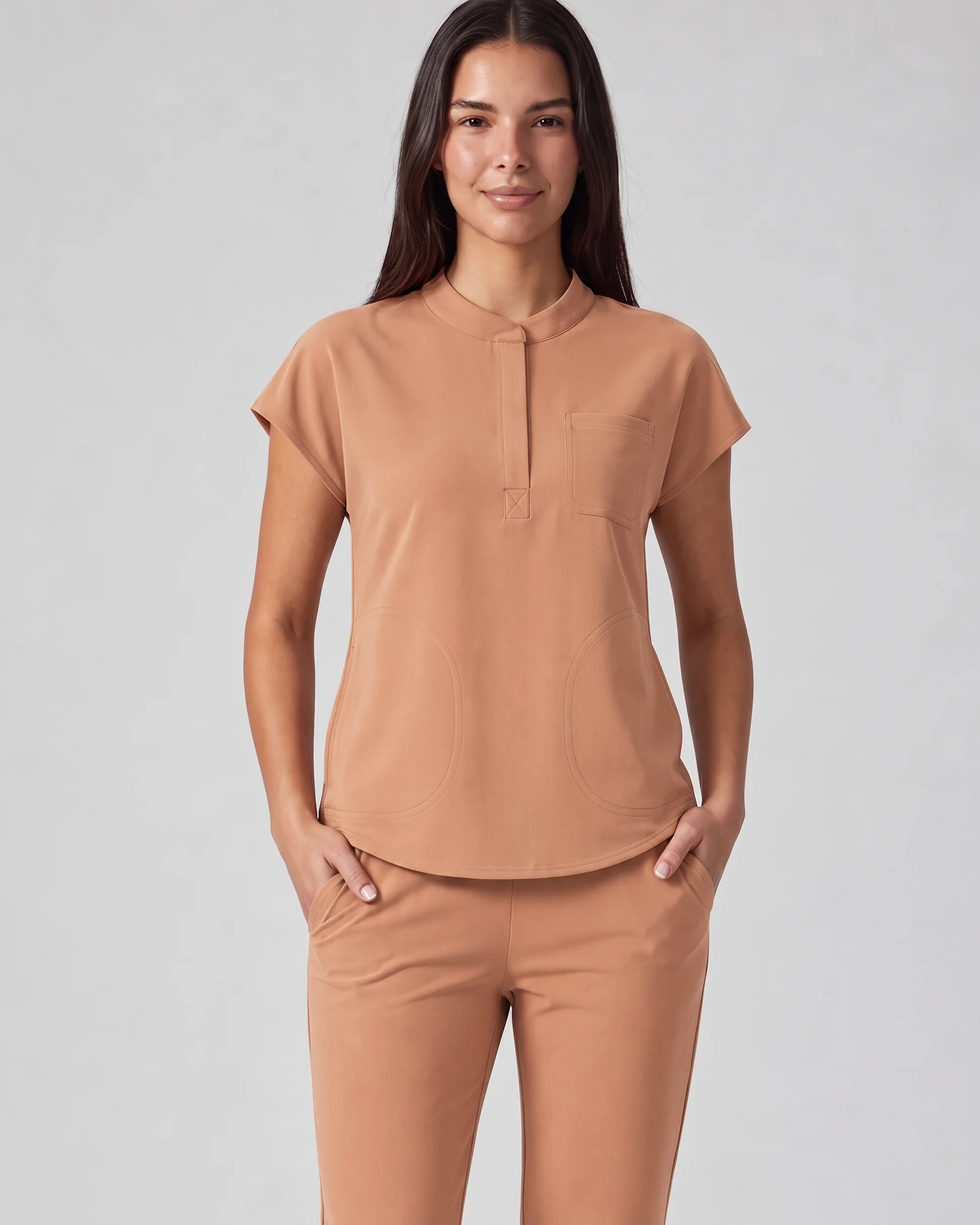
Front Desk image: the collar, covered placket, short sleeves, chest pocket, and lower front pockets are visible. The photo does not prove role suitability, fit, movement, opacity, client response, protection, or durability; the pants are sold separately.
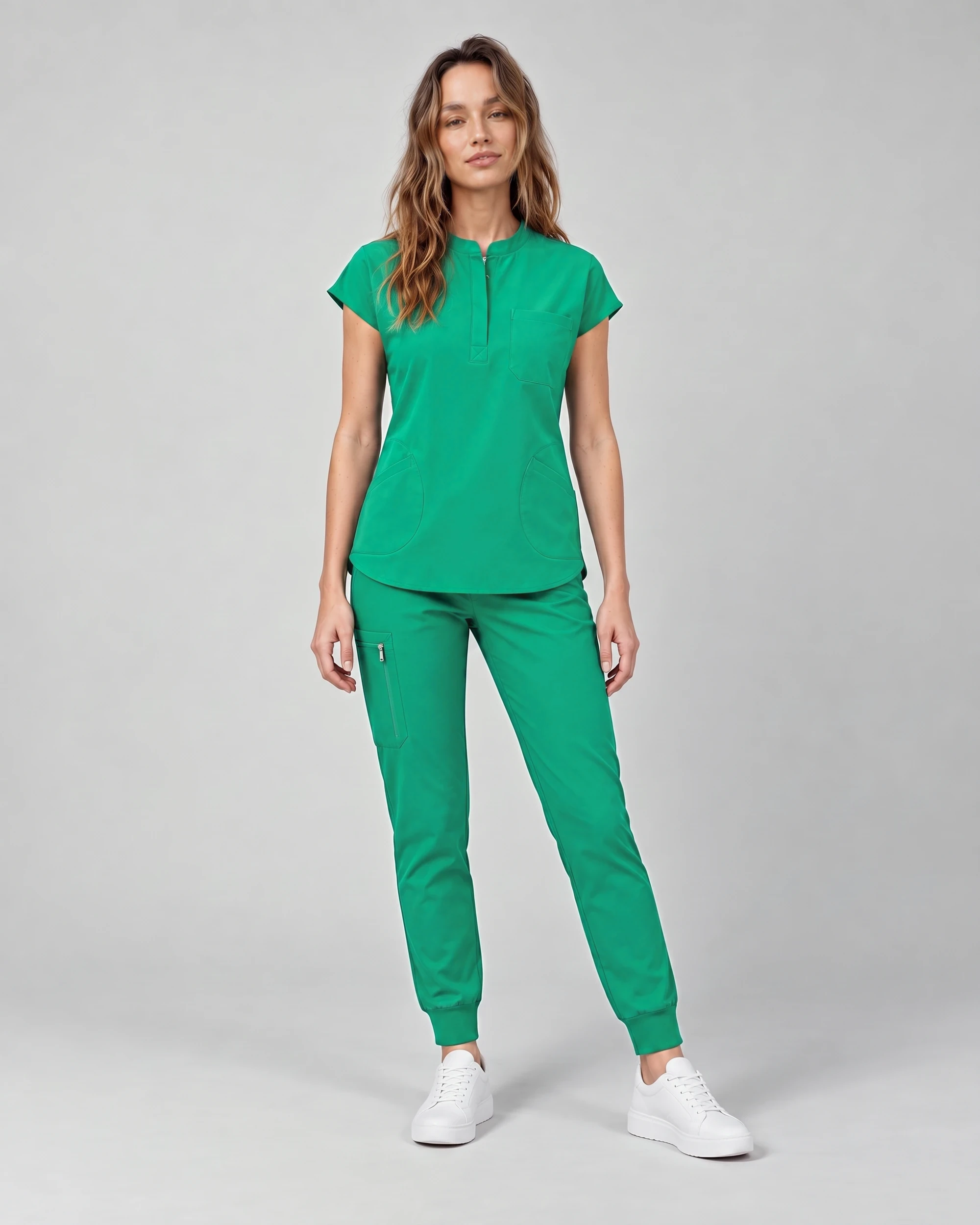
Motion image: the front view shows the coordinated top, tapered pant, and ankle cuffs. The photo does not prove fit, range of motion, pocket performance, opacity, protection, client response, or durability.
Once the requirements sheet has narrowed the options, shop current LumiScrubs scrubs and put one clean outfit through the room-to-room trial before multiplying the order.
For a dated evidence audit and more neckline options, see the best med spa scrubs comparison. This page is the role-and-route worksheet; the comparison page audits product facts.
Frequently asked questions
What are the best med spa scrubs?
There is no universal winner. Start with the written rule, room-to-room tasks, protective clothing and equipment, movement, lighting, layers, pockets, shoes, care, and return conditions. Test the exact outfit before buying multiples.
Do estheticians wear scrubs?
Some workplaces use them, but the employer and applicable professional rules decide what is allowed for the exact role and services. Confirm the current local rule rather than copying another practice’s uniform.
What color scrubs should a med spa team wear?
Use the practice’s approved color name or product code. If the team is choosing a new palette, inspect the exact garments under the real room lighting and use a separate visible identifier when roles need to be clear.
Are collared scrub tops better for front-desk work?
A collar is a visible construction choice, not proof of better performance or client response. Compare it with the written appearance standard, layers, badge or logo position, seated-forward fit, and return conditions.
Are joggers or straight-leg pants better for estheticians?
The job title does not decide. Compare the permitted shapes with the wearer’s measurements, shoes, cuff or hem clearance, repeated positions, and adjustment notes.
Do ordinary scrubs protect workers during services?
Do not assume so. The workplace hazard assessment and exact task determine the controls, protective clothing, and equipment required; a garment name, fabric ratio, surface finish, color, or sleeve is not a substitute.