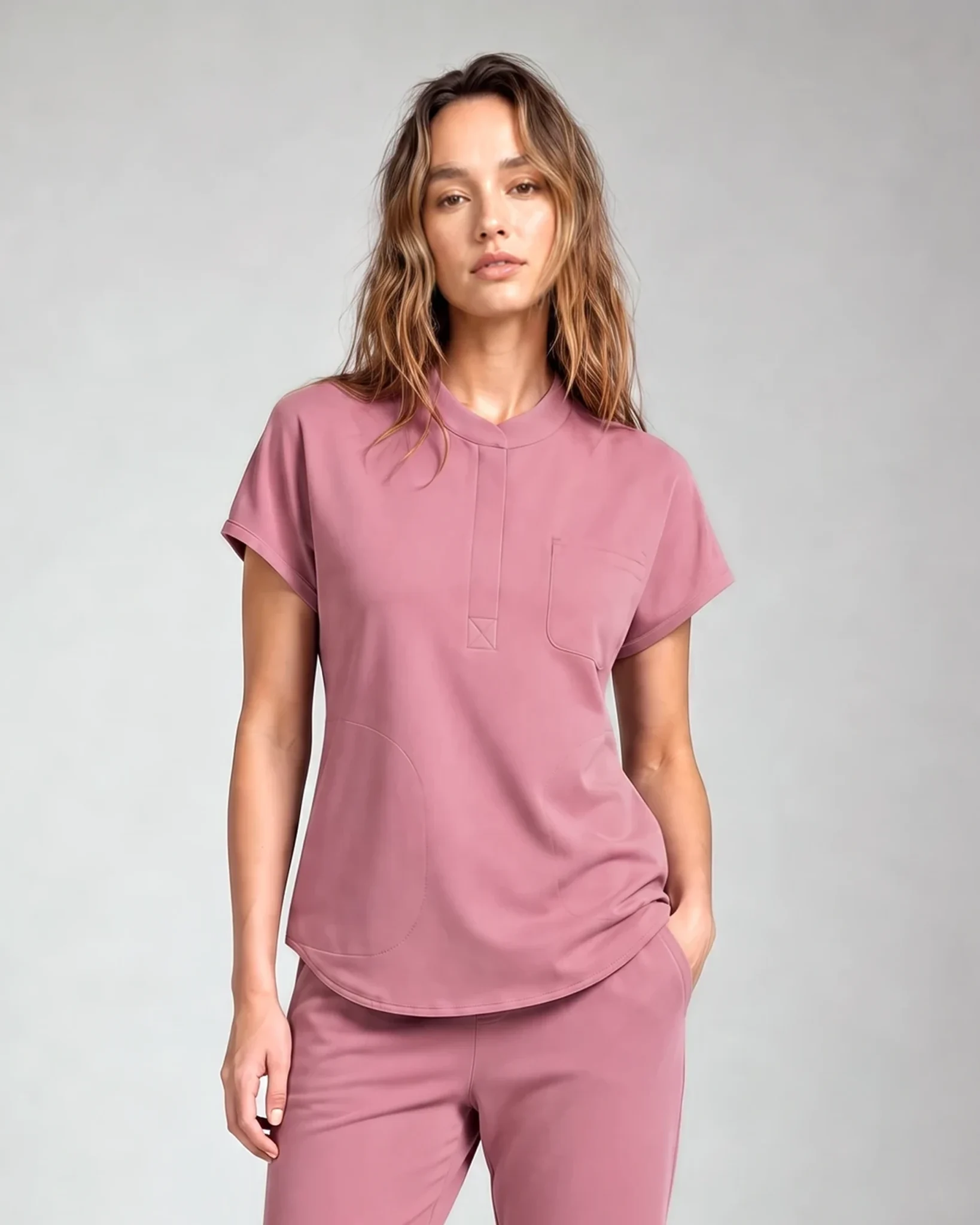

For a cold dental office, start with an approved close-fitting base layer, add your normal scrub top, and keep any removable outer layer within the practice rules. The right system adds warmth without creating loose sleeves, neckline bulk, restricted shoulders, or a fit that changes when you sit and reach.
Do not solve the problem by automatically buying a thicker or larger scrub top. First identify when you feel cold and which layers are permitted during patient care.
Ask what the practice allows
Before buying a base layer or jacket, confirm:
- whether long sleeves can be worn during patient care;
- whether the sleeve color must match the uniform;
- whether a jacket or cardigan must be removed for certain tasks;
- whether personal outerwear is allowed in clinical areas;
- how often each layer must be changed or laundered;
- whether the practice supplies a specific jacket.
The rule can vary by workplace and task. This article cannot replace your employer’s dress, safety, or infection-control policy.
Find the cold point in your day
Your solution depends on when the problem appears.
- Cold all shift: begin with a base layer that can remain under the scrub top.
- Cold only between patients: a removable approved outer layer may be more flexible.
- Cold arms, comfortable core: focus on sleeve coverage rather than adding bulk everywhere.
- Warm during movement, cold while charting: choose a layer you can add and remove without changing the scrub fit.
- Cold after perspiring: prioritize a dry replacement layer and follow the garment care instructions.
This simple diagnosis prevents buying a layer that feels helpful for ten minutes but becomes uncomfortable during the rest of the shift.
Layer 1: choose a close base layer
A base layer should sit smoothly under the scrub top and move with your shoulders and elbows. Look for:
- a neckline that stays hidden or meets the dress code;
- sleeves that do not bunch at the wrist;
- enough stretch for reaching and bending;
- seams that do not rub under the outer top;
- care instructions compatible with your workwear laundry routine.
The Women’s Quick-Dry Long-Sleeve Underscrub is a current LumiScrubs base-layer option. It is available in black and white; check the live product page for current size availability.
Do not assume you must size up the outer scrub top. Test your normal size over the base layer first. If the shoulders, upper back, neckline, or armholes become restricted, compare the measurements or another cut rather than relying on a universal sizing rule.
Layer 2: keep the scrub top functional
The outer scrub top still needs to work as a uniform. Once layered, repeat the same checks you would use without a base layer:
- Reach forward and overhead.
- Sit and lean forward.
- Check neckline and back coverage.
- Confirm pocket access.
- Look for bunching at the shoulder, underarm, and waist.
A higher neckline can feel different from a V-neck, but neckline shape alone does not prove that one top is warmer. Choose by coverage, fit, and workplace policy.
Layer 3: use removable warmth deliberately
If permitted, a jacket or cardigan can help during charting, breaks, or other periods when you are less active. It should be easy to remove and store according to the practice’s rules.
Check cuff security, sleeve length, closure, and pocket contents. Loose cuffs or excess sleeve fabric can interfere with hands-on work even when the layer feels comfortable while standing.
Keep the color system clean
A visible base layer becomes part of the uniform. Under bright operatory lighting, check the complete outfit from the front, side, and back.
- Match dark layers when the practice expects a uniform look.
- Under a pale top, test whether the base layer shows through.
- Avoid visible graphics unless approved.
- Confirm whether contrasting sleeves are permitted.
Use the actual office lighting if possible; a bedroom mirror may not reveal the same contrast.
Run a two-temperature fit test
Test the outfit when you first put it on and again after several minutes of movement.
First check
- Is the neckline smooth?
- Can you bend your elbows fully?
- Do the sleeves stay in place?
- Does the outer top still fall cleanly?
After movement
- Are you overheating?
- Has the base layer twisted or ridden up?
- Does moisture remain against the skin?
- Can you remove the outer layer without disrupting the uniform?
The best system is adjustable. It should not force you to choose between being cold while charting and overheated while moving.
Laundry planning matters
Every layer worn during work adds to the laundry rotation. Read each garment’s label separately; a base layer and scrub top may not share identical care instructions.
Keep enough approved layers to match your laundry schedule, and do not personalize a new garment until its fit is final. LumiScrubs’ current return window applies to eligible non-personalized items that remain unworn, unwashed, and in original packaging. See Shipping & Returns for the current terms.
Cold-office checklist
Before ordering, answer:
- Which parts of my body feel cold?
- When during the shift does it happen?
- Are long sleeves permitted during patient care?
- Will the neckline and sleeve color meet the uniform policy?
- Does my scrub top still move correctly over the layer?
- Can I remove an outer layer when activity increases?
- Can I maintain the extra laundry rotation?
Cold dental-office comfort is a system, not a single “warmest scrub.” Start with the workplace rules, solve the specific cold point, and test the complete outfit before committing to multiple pieces.
Frequently asked questions
Should I size up my scrub top over an underscrub?
Not automatically. Test your normal size over the base layer, then compare another size or cut if the shoulders, upper back, armholes, or neckline become restricted.
What color should I wear under a light scrub top?
Use a color permitted by the practice and check the complete outfit under bright light. The best choice is the one that meets the uniform policy without showing through.
Is a jacket better than a long-sleeve base layer?
They solve different moments. A base layer can provide continuous coverage when permitted; an approved jacket is easier to remove when activity increases.